 EatSee
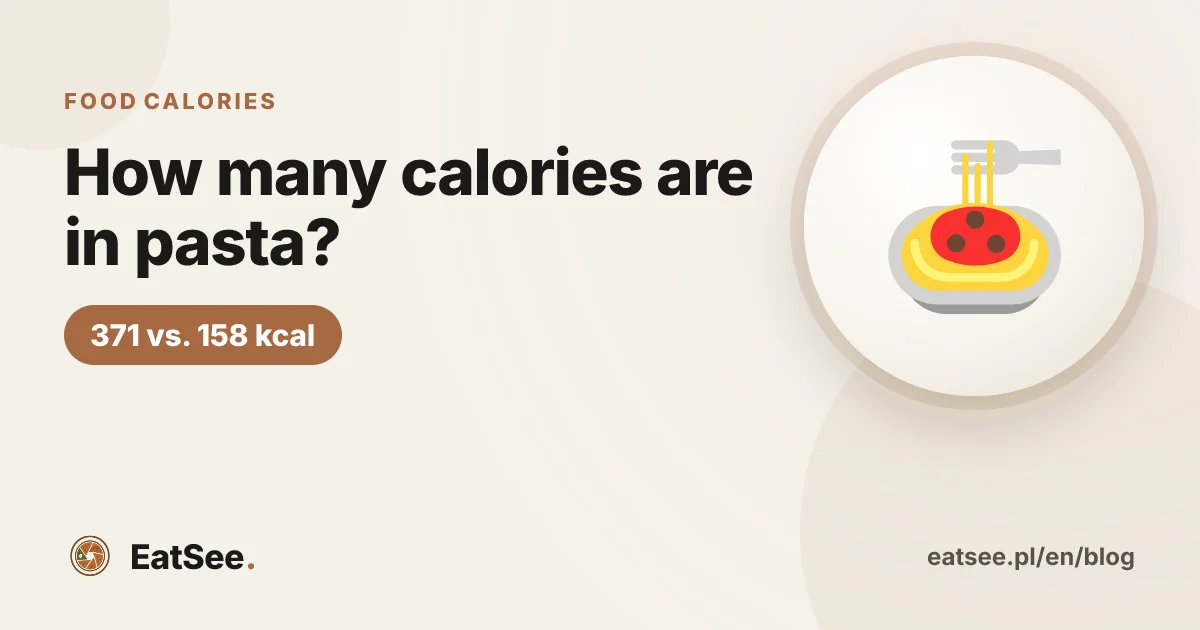
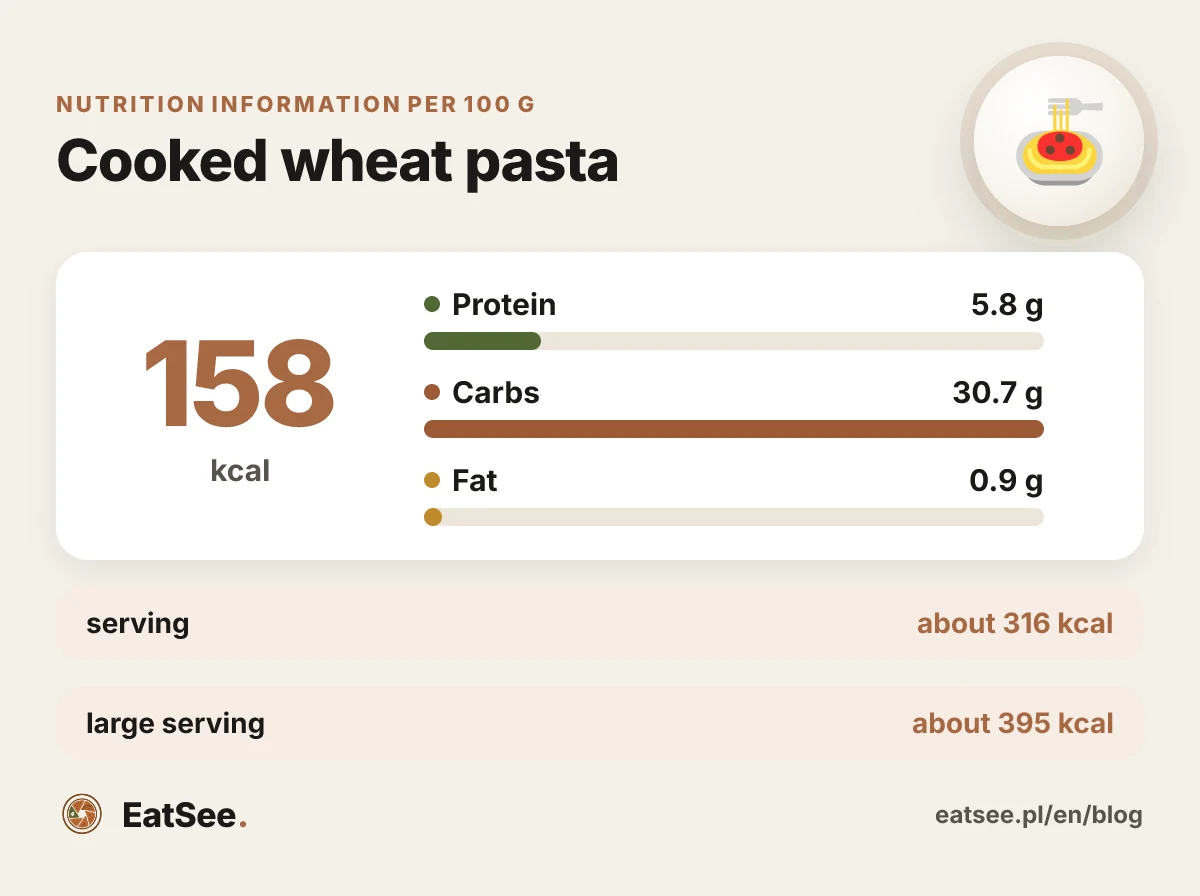
How many calories are in pasta? 100 g of dry wheat pasta has about 371 kcal, while 100 g of cooked pasta has about 158 kcal. So a typical 200 g serving after cooking has about 316 kcal, before adding sauce. The difference is mainly due to the water pasta absorbs during cooking, not because the calories disappear.
- servingabout 316 kcal
- large servingabout 395 kcal
How many calories are in dry pasta versus cooked pasta?
Pasta nutrition information on the package is usually listed for the dry product. It weighs more after cooking because it absorbs water, but its total energy remains about the same. That’s why 100 g of dry pasta and 100 g of cooked pasta represent very different amounts of pasta before cooking.
| Type of pasta | Calories per 100 g | Calories per 200 g serving |
|---|---|---|
| Wheat, dry | about 371 kcal | about 742 kcal |
| Wheat, cooked | about 158 kcal | about 316 kcal |
| Whole wheat, dry | about 352 kcal | about 704 kcal |
| Whole wheat, cooked | about 149 kcal | about 298 kcal |
These are estimates for typical products. The brand, ingredients, and cooking time can change the result, and al dente and very soft pasta may absorb different amounts of water. You can check the values for dry wheat pasta and cooked wheat pasta in the calorie chart.
Don’t add oil to the cooking water thinking it will lower the calorie content — it won’t. If you add fat that stays on the pasta, you’ll increase the calories in the dish. Cooking pasta in water alone doesn’t add energy.
How many calories are in a serving of pasta?
The easiest way to estimate a serving is to weigh the pasta before cooking. That way, you don’t have to guess how much water it absorbed or how large the serving looks on your plate. For regular wheat pasta, you can use these estimates:
| Dry pasta weight | Calories before adding sauce |
|---|---|
| 60 g | about 223 kcal |
| 75 g | about 278 kcal |
| 90 g | about 334 kcal |
If you weigh the pasta after cooking, 150 g has about 237 kcal, 200 g has about 316 kcal, and 250 g has about 395 kcal. A 75 g serving of dry pasta may weigh roughly 170–190 g after cooking, but it depends a lot on the shape and cooking time. These conversions aren’t a perfect substitute for weighing, so if you track regularly, choose one method and stick with it.
A restaurant serving or a home-cooked plate served “by eye” can weigh much more than the standard amount in a recipe. If it’s hard to estimate the amount without a scale, try this simple way to estimate a serving. And if you’re comparing pasta with another side dish, see how many calories are in rice too. As with pasta, it matters whether you’re counting it dry or cooked.
Does whole wheat pasta have fewer calories?
It usually has slightly fewer calories per 100 g, but the difference isn’t huge. In the values shown, 100 g of dry whole wheat pasta has about 352 kcal, compared with about 371 kcal for wheat pasta. Once cooked, that’s about 149 and 158 kcal per 100 g, respectively.
Whole wheat pasta often provides more fiber, but the amount depends on the product. Some people also find it more filling, although that depends a lot on the whole meal, the serving size, and what you serve alongside it. Choose the kind you enjoy and that works for your dish — you don’t have to swap every pasta for whole wheat.
How many calories are in pasta with sauce?
The calories in a plate of pasta depend on the sauce and toppings as well as the pasta itself. A 200 g serving of cooked pasta has about 316 kcal. Add 100 g of simple tomato sauce, worth about 50 kcal, and the whole meal will have about 366 kcal.
Olive oil, cream, cheese, or meat can raise the total. For example, you could add 5 g of olive oil, about 45 kcal, and 10 g of Parmesan, about 40 kcal, to pasta with tomato sauce. In this example, the whole serving has about 451 kcal: 316 kcal from the pasta, 50 kcal from the sauce, 45 kcal from the olive oil, and 40 kcal from the cheese.
| Example toppings for 200 g of cooked pasta | Estimated calories for the whole dish |
|---|---|
| 100 g of simple tomato sauce | about 366 kcal |
| Tomato sauce, 5 g of olive oil, and 10 g of Parmesan | about 451 kcal |
| 100 g of cream sauce, depending on the recipe | about 466-566 kcal |
Bolognese sauce, pesto, and store-bought jarred sauces can also vary in calories. The amount of fat, cheese, and meat, along with the serving size, makes the biggest difference. If you’re making the dish at home, count the ingredients separately and then divide the total by the number of servings. That’s more accurate than assigning one calorie value to every pasta dish with sauce.
Can pasta fit into a weight loss plan?
Yes. Pasta itself doesn’t prevent weight loss — what matters is your total daily energy intake, serving size, and whether your way of eating is sustainable day to day. You don’t have to give up Friday spaghetti or lunch at your mom’s. It’s worth accounting for the sauce and toppings, though, as they can turn a light serving into a very high-calorie plate.
You could start by measuring out 60–75 g of dry pasta and adding a source of protein, vegetables, and an amount of sauce you can easily control. This is just an example serving, not a strict rule — your needs depend on your overall meal plan, activity, and goal. To better understand how energy balance works, read how to count calories and how a calorie deficit works.
You could also add more vegetables to the dish or choose a tomato-based sauce if that’s what you feel like. The point isn’t to make every meal lower in calories at all costs. It’s about choosing a serving that leaves you satisfied and fits your goal.
How do you count the calories in pasta day to day?
Choose one of two methods:
- Weigh dry pasta and check the nutrition information on the package or in a chart. This is the simplest option if you’re cooking one serving.
- Weigh pasta after cooking and use the values for cooked pasta. Don’t compare this weight with a chart for dry pasta.
- Add the sauce and other ingredients separately—especially olive oil, cheese, cream, and meat.
- Log the whole recipe if you’re cooking several servings, then divide the total calories by the number of servings or by their total weight.
When tracking a meal, you can use the EatSee app, which estimates calories and macronutrients from a photo or description. You can adjust the result by changing the serving size or an ingredient. It’s a convenient way to log a skillet meal, but when making a homemade recipe, it’s still worth keeping track of how much of the most calorie-dense ingredients you add.
If you’d rather get ideas for ready-made meals, check out meal plans for 7 days and use them as inspiration, not as a personalized plan. Pasta can easily be part of your meal plan, even when you’re counting calories. The key is to track the same form of the product that’s actually on your plate.
FAQs
How many calories are in 100 g of cooked pasta?
How many calories are in 100 g of dry pasta?
How many calories are in a 200 g serving of pasta?
Is whole-wheat pasta lower in calories?
Can you eat pasta while losing weight?
This article is for informational purposes and does not replace advice from a doctor or dietitian. Nutrition information is approximate—it depends on the variety, brand, and preparation method. Check the product packaging for exact information. This article was prepared by the EatSee editorial team. Editorial policy.