 EatSee

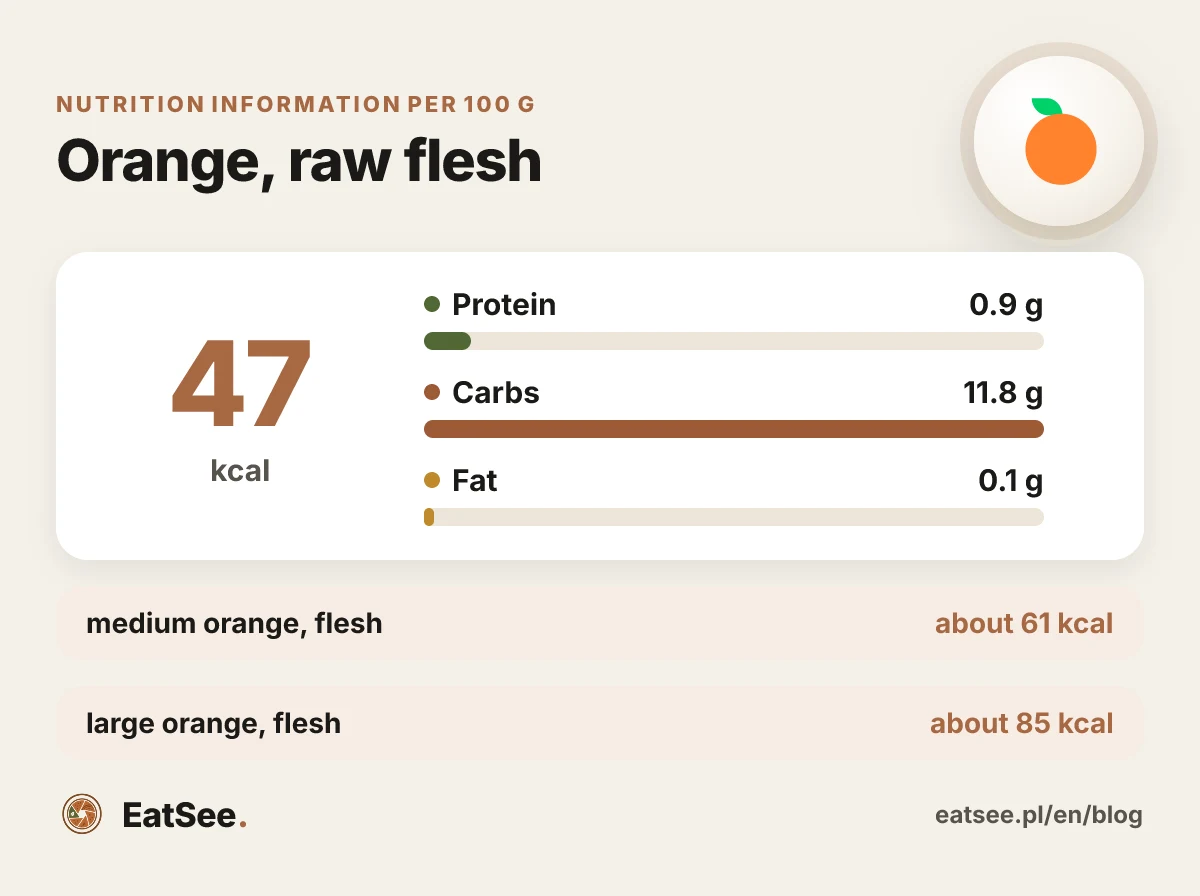
How many calories are in an orange? 100 g of flesh contains about 47 kcal, while a medium orange with about 130 g of edible flesh contains about 61 kcal. For comparison, 200 g of orange juice contains about 98 kcal. An orange can easily be part of a weight loss plan—your overall diet matters, not one fruit.
- medium orange, fleshabout 61 kcal
- large orange, fleshabout 85 kcal
How many calories are in 100 g of orange and in one whole orange?
An orange contains about 47 kcal per 100 g of flesh. So the calories in a whole orange depend mainly on the weight of the peeled fruit, not whether it looks “small” or “large.” We don’t eat the peel, so don’t include it in the serving weight.
| Serving | Weight of edible flesh | Calories |
|---|---|---|
| Orange flesh | 100 g | about 47 kcal |
| Medium orange | 130 g | about 61 kcal |
| Large orange | 180 g | about 85 kcal |
| Orange juice | 100 g | about 49 kcal |
| Serving of juice | 200 g | about 98 kcal |
The values in the chart are estimates and have been rounded. They may vary slightly depending on the variety and size of the fruit, as well as the juice’s ingredients and preparation method. See the orange calorie chart for more information.
To calculate your serving more precisely, peel the fruit and weigh the flesh alone. Then multiply its weight by 0.47—for example, 150 g of flesh contains about 71 kcal. If you don’t have a scale, you can estimate that a medium orange has about 130 g of edible flesh, but individual fruits can vary.
How many calories are in orange juice?
Orange juice contains about 49 kcal per 100 g. A 200 g serving—roughly a cup, depending on the glass—provides about 98 kcal. That’s similar to the calories in one large orange, but juice is usually quicker to drink than fruit is to eat.
| Serving of orange juice | Calories |
|---|---|
| 100 g | about 49 kcal |
| 200 g | about 98 kcal |
Even 100% orange juice contains calories and naturally occurring sugars. It’s not the same as a sweetened drink, but it also doesn’t replace a whole orange for fiber—most of the flesh is separated during juicing. Check the label for the calories in a packaged product, as different juices and drinks can have different ingredients. See also our separate chart: how many calories are in orange juice.
If you’re in the mood for an orange but want a filling snack, eating the fruit is usually more practical than drinking the juice. You can also add orange segments to yogurt, oatmeal, or a salad. That makes it easier to see how much you’re having and pair it with other meal ingredients.
Can oranges fit into a weight loss plan?
Yes. Oranges don’t prevent weight loss, and you don’t need to cut them from your menu. A medium orange contains about 61 kcal, so for many people it can simply be a fruity snack or an addition to a meal. What matters is your overall food intake throughout the day and week.
A whole fruit also contains fiber and takes chewing, which may help you eat it more slowly than juice. That doesn’t mean juice is off-limits—it’s just easy to drink a larger serving before you feel like you’ve eaten something. If you track calories, include juice, smoothies, and oatmeal toppings in your daily total too.
Weight loss doesn’t require giving up fruit or eating only “healthy” foods. An orange can add variety to breakfast, dessert, or a snack at work. To better understand how a calorie deficit works, remember that it comes from your overall meal plan, not one individual food.
Orange or juice—which should you choose for a snack?
It depends on what you feel like and what your day looks like. A whole orange is easy to eat between meals, while juice can be part of breakfast or simply a drink you’re in the mood for. Neither choice is automatically “good” or “bad.”
When comparing servings, keep in mind that one medium orange contains about 61 kcal, while 200 g of juice contains about 98 kcal. The difference is partly due to serving size—a glass of juice may contain juice from more than one fruit. If you want to check the exact value for a particular drink, look at the label and adjust it to the amount you actually pour.
An orange also provides carbs, small amounts of protein and fat, and fiber. 100 g of flesh contains about 11.8 g of carbs, 0.9 g of protein, 0.1 g of fat, and 2.4 g of fiber. If you’re comparing fruits, check out calories in an apple too—the serving size, as with oranges, has a big impact on the total.
How can you include an orange in your daily calorie count?
The simplest option is to record the weight of the edible part or choose an entry in the app that matches the serving you ate. If you added orange to your oatmeal, log it separately from the oats and other ingredients. For juice, record the amount you drank rather than just noting “a small cup”—cups can vary surprisingly in size.
Here’s one way to do it:
- Peel the orange and, if you have a scale, weigh the flesh.
- Multiply the number of grams by 0.47 to estimate the calories.
- For juice, check the label and calculate the value for the amount you drank.
- Log the addition separately if you want to know where the calories in the whole meal come from.
If weighing every piece of fruit doesn’t work for you, there’s no need to make yourself do it—a portion estimate can be useful, too. In our simple guide to calorie counting, you’ll find more tips on how to do it without turning every meal into a math problem. To log a mixed dish, you can use the photo calorie tracker. The app estimates nutrition information, so treat the result as an approximation and adjust it if you know the exact portion.
Oranges have a moderate calorie content: about 47 kcal per 100 g and about 61 kcal for a medium orange. Juice has about 49 kcal per 100 g, while a 200 g serving contains about 98 kcal. Choose the form that works with your meal and include it in your usual meal plan.
FAQs
How many calories are in a medium orange?
How many calories are in 100 g of orange?
How many calories are in a cup of orange juice?
Do oranges cause weight gain?
Can you eat oranges while trying to lose weight?
This article is for informational purposes and does not replace advice from a doctor or dietitian. Nutrition information is approximate—it depends on the variety, brand, and preparation method. Check the product packaging for exact information. This article was prepared by the EatSee editorial team. Editorial policy.