 EatSee
How many calories are in champagne? Brut usually has about 75-85 kcal per 100 ml, or about 94-106 kcal in a 125 ml glass. Sweeter sparkling wine can contain about 90-120 kcal per 100 ml. The main factors are alcohol, sugar content, and pour size—not the bubbles themselves.
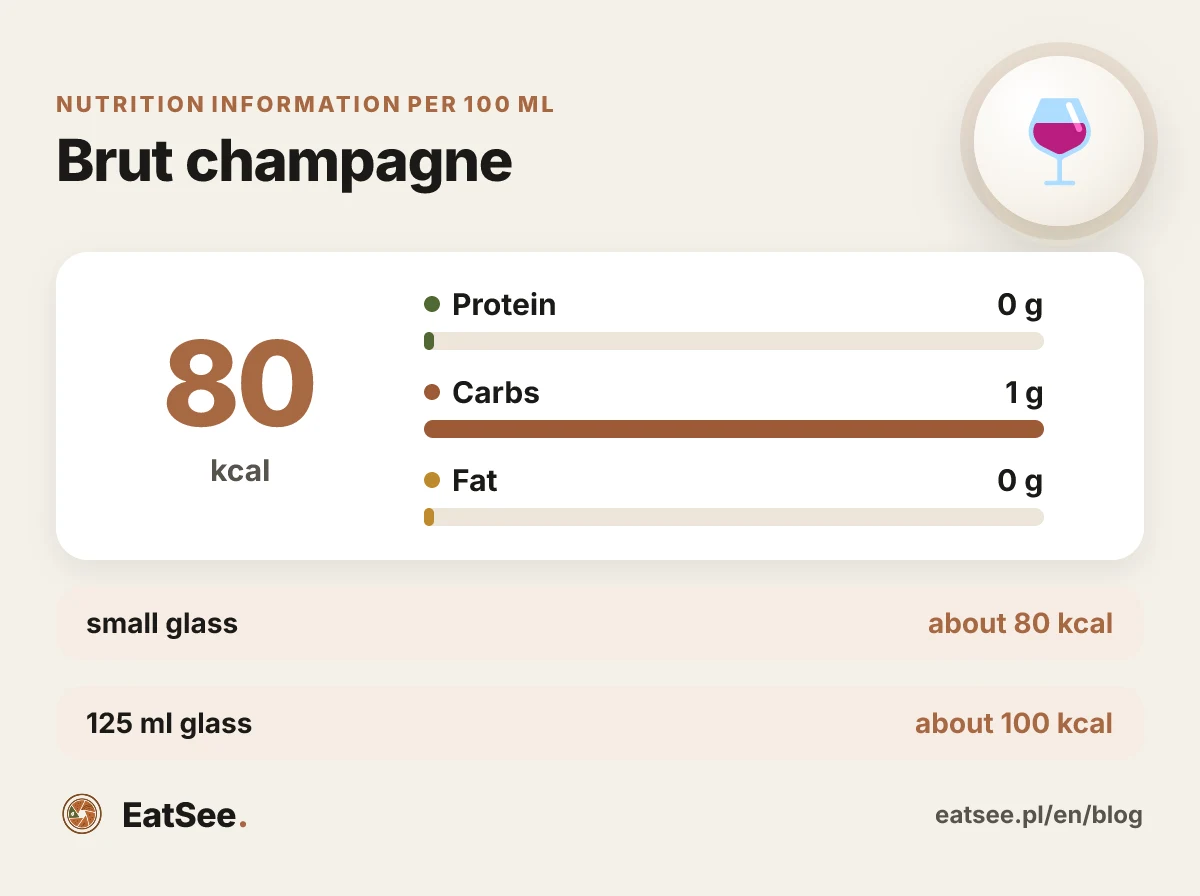
- small glassabout 80 kcal
- 125 ml glassabout 100 kcal
How many calories are in a glass of champagne?
A typical glass holds about 100-125 ml, but it's easy to pour more during a toast. That's why counting “glasses” can be imprecise—one might be a modest pour, while another could hold almost twice as much.
| Type of sparkling wine | Calories per 100 ml | Calories in a 125 ml glass |
|---|---|---|
| Brut nature, extra brut, or brut | about 75-85 kcal | about 94-106 kcal |
| Extra dry or sec | about 80-95 kcal | about 100-119 kcal |
| Demi-sec | about 90-105 kcal | about 113-131 kcal |
| Doux or other sweet varieties | about 100-120 kcal | about 125-150 kcal |
These are estimates. A specific bottle may have a different alcohol and sugar content, and the terms for sweetness aren't always intuitive: “extra dry” is usually sweeter than brut. To compare champagne with other drinks, check the drink calorie chart or see how many calories are in beer.
It's also worth distinguishing between the names. Champagne is sparkling wine from the Champagne region of France, while prosecco and cava are other types of sparkling wine. People often lump them together in everyday conversation, but their calorie content can vary—check the alcohol and sugar content, and serving size.
What makes champagne contain calories?
Alcohol is the main source of energy in sparkling wine. It provides about 7 kcal per 1 g, while sugar provides about 4 kcal per 1 g. The bubbles themselves don't add calories, though they can make the drink seem lighter and easier to drink quickly.
Brut varieties are low in sugar, but they still contain alcohol. Sweeter sparkling wines can have more calories because they contain more sugar as well as alcohol. So “dry” doesn't mean calorie-free.
The drink's strength matters too. Two wines with similar sweetness can have different calorie counts if one contains more alcohol. Treat the figures as reasonable estimates, not fixed values for every bottle.
Dry or sweet—which should you choose if you're counting calories?
For similar serving sizes, brut is usually lower in calories than sweeter varieties. The difference in one glass may not be huge, but it becomes more noticeable after several servings and with sweet mixers.
You don't have to choose a drink based only on calories, though. If you prefer a sweeter taste, you can pour a smaller serving or drink more slowly, alternating with water. It's a simple way to keep track of how much you're drinking, without labeling one type of drink “good” and another “bad.”
Keep in mind that glasses at home and at a party aren't always the same size. If you want to estimate a serving without weighing it, try this simple way to estimate portions without a scale. For alcohol, though, the most accurate approach is to check how many milliliters you're actually pouring.
How many calories are in champagne cocktails?
Mixers can change the calorie count more than the difference between two dry bottles. Juice, liqueur, syrup, or fruit puree add their own calories, and it's easy to pour drinks by eye. The examples below use standard amounts of each ingredient:
| Drink | Example serving | Calories |
|---|---|---|
| Mimosa | 100 ml of sparkling wine and 100 ml of orange juice | about 120-130 kcal |
| Bellini | 100 ml of sparkling wine and about 50 g of peach puree | about 95-115 kcal |
| Kir Royale | 100 ml of sparkling wine and about 15 ml of blackcurrant liqueur | about 110-130 kcal |
The total depends on the proportions and the specific juice, puree, or liqueur. Refills add up too—a classic New Year's Eve situation, when no one remembers whether the glass is on its first or second pour.
If you're making drinks at home, measure the ingredients, even with a kitchen measuring cup. You can also use less juice or liqueur if you prefer a less sweet taste. Sparkling water isn't a must-have with champagne, but a glass of water between alcoholic drinks can help you pace yourself and stay hydrated.
How do you count calories from champagne day to day?
First estimate the serving size, then multiply the calories per 100 ml by the number of milliliters and divide by 100. For example, if brut has about 80 kcal per 100 ml, a 125 ml glass has about 100 kcal. Two glasses like that come to roughly 200 kcal—with no extra juice or liqueur.
When logging, don't leave out alcohol just because it's a drink rather than food. Enter the type of drink and a serving size as close as possible to what you actually had. If you don't know the exact amount, choose an estimate for a similar type and don't pretend the pour was exactly 100 ml.
You can log drinks manually or use the photo calorie tracker to make tracking your meals easier, too. For an alcoholic drink, add the ingredients and their amounts—the photo alone may not show how much juice or liqueur went into the glass. Find more practical tips in our guide on how to count calories.
Alcohol on New Year's Eve—what should you keep in mind?
Calories are only one part of the picture. Alcohol can affect your judgment and coordination, so don’t drive or do anything that requires your full attention after drinking. If you’re driving, choose a nonalcoholic drink.
Avoid alcohol during pregnancy. If you take medication, have a health condition, or have any concerns, it’s best to talk to a doctor or pharmacist. There’s also no need to “make up for” drinking champagne by fasting or doing an extra workout. A regular meal, some water, and a relaxed approach the next day are better than punishing yourself for a New Year’s Eve toast.
FAQs
How many calories are in a glass of brut champagne?
Does sweet champagne have more calories than brut?
How many calories are in a mimosa?
Is brut champagne sugar-free?
Do bubbles have calories?
This article is for informational purposes and does not replace advice from a doctor or dietitian. Nutrition information is approximate—it depends on the variety, brand, and preparation method. Check the product packaging for exact information. This article was prepared by the EatSee editorial team. Editorial policy.