 EatSee
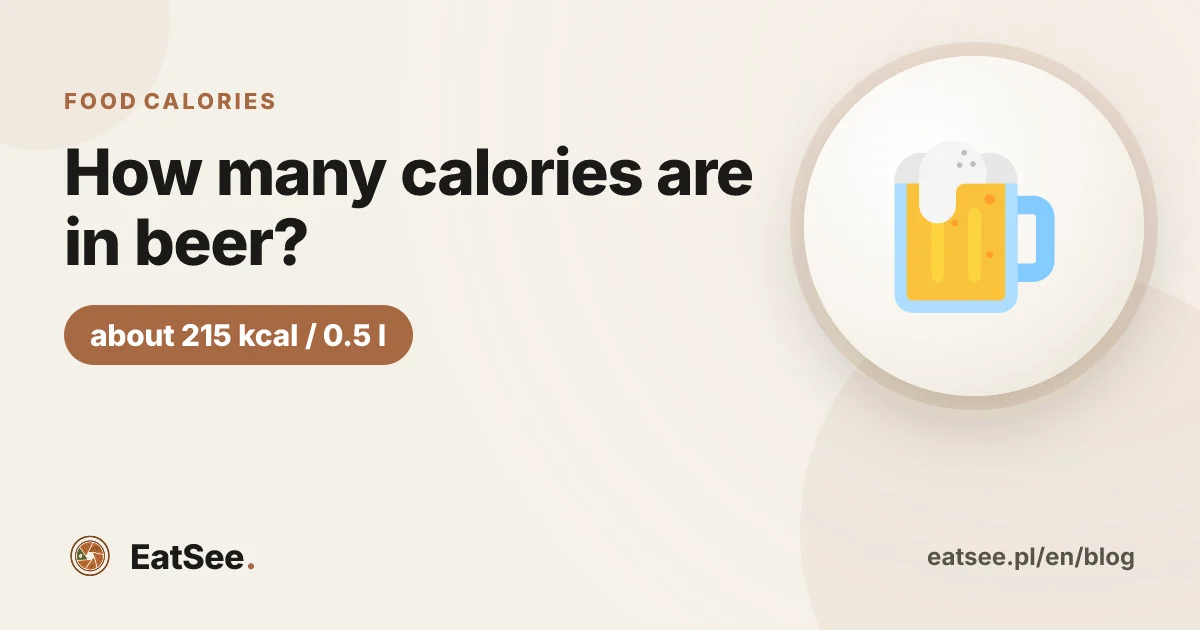
How many calories are in beer? A light lager with an alcohol content of around 4.8% has about 43 kcal per 100 ml, so a 0.5 l bottle or can provides about 215 kcal. Dark, non-alcoholic, and fruit radlers can have different values, so treat the figures below as estimates - the recipe and alcohol content make a difference.
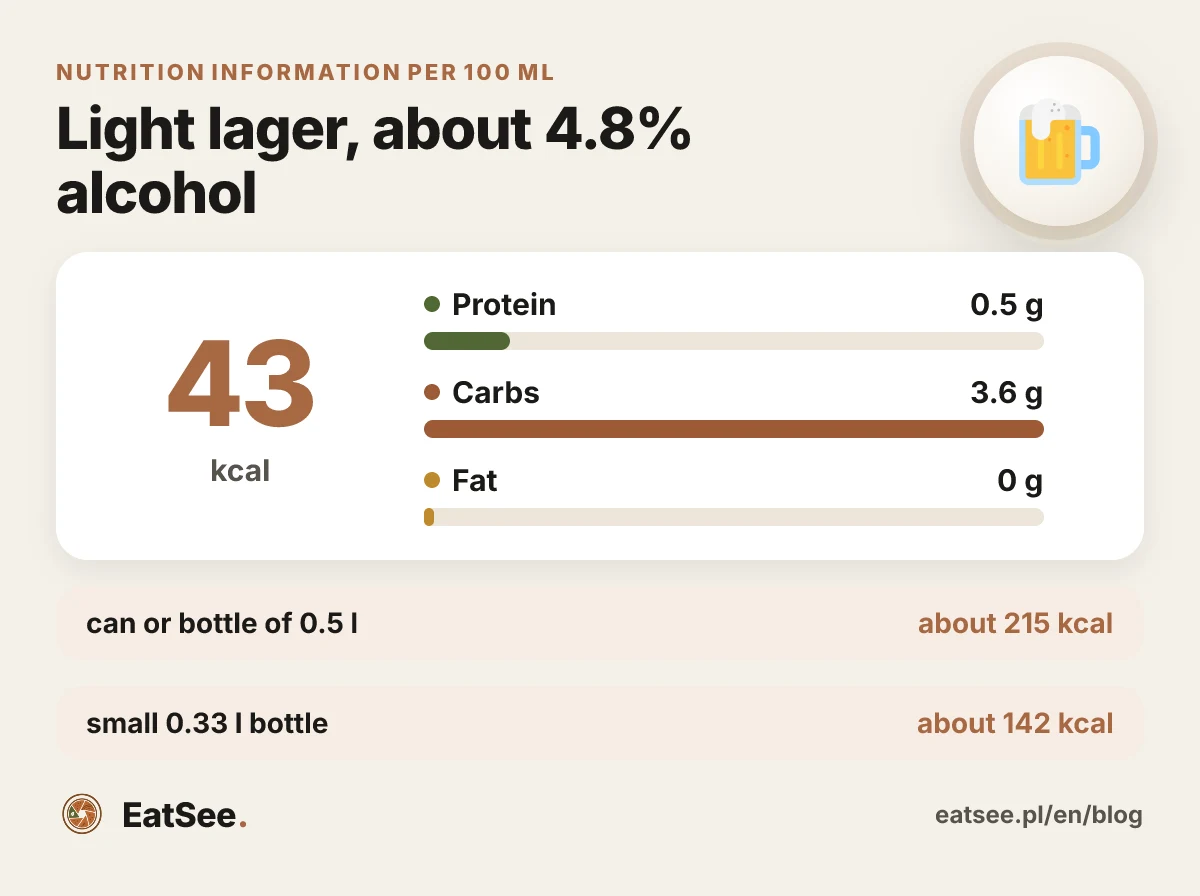
- can or bottle of 0.5 labout 215 kcal
- small 0.33 l bottleabout 142 kcal
How many calories are in 0.5 l of beer?
A typical light beer with an alcohol content of around 4.8% has approximately 43 kcal per 100 ml. A half-liter serving has about 215 kcal. A small 0.33 l bottle has about 142 kcal, assuming the same value per 100 ml.
| Beer type | Calories per 100 ml | Calories per 0.5 l |
|---|---|---|
| Light lager, about 4.8% | about 43 kcal | about 215 kcal |
| Dark | about 40-60 kcal | about 200-300 kcal |
| Non-alcoholic | about 20-30 kcal | about 100-150 kcal |
| Radler | about 35-55 kcal | about 175-275 kcal |
The values for light beer are based on an example lager. You can also check the calories in light beer and compare them with other drinks in the calorie chart for drinks. The label on the specific beer is the best source of information about that particular variety.
Does a can of beer have the same calories as a bottle?
If a can and a bottle are both 0.5 l and contain the same beer, they have practically the same calorie content. The packaging doesn't add calories - what matters is the amount of drink, its ingredients, and its alcohol content. So a 0.5 l can of light lager has about 215 kcal, as does a bottle of the same size.
Be sure to check the serving size. You might see 0.33 l, 0.5 l, and larger packages side by side on the shelf, and the difference in calories increases in proportion to the serving. If you drink two 0.5 l cans, don't count them as one: for the example light beer, that's about 430 kcal.
It's easy to lose track when pouring beer into a glass, especially if it's a large one. Log the amount you actually drank, not the capacity of the glass. If it's hard to estimate servings, a guide to estimating a serving without a scale may help.
Light, dark, non-alcoholic, or radler - which has fewer calories?
Light lager is a useful reference point, but the color of beer alone doesn't tell you how many calories it has. Dark beer may have a similar calorie content to light beer or a higher one, depending on its alcohol content, malt extract, and recipe. For typical varieties, we've used a broad range of about 40-60 kcal per 100 ml; stronger beers may fall outside this range.
Non-alcoholic beer often has fewer calories because it contains little or no alcohol. It usually provides about 20-30 kcal per 100 ml, but it's worth checking the label. Some varieties contain more carbs or sugars, and the term “non-alcoholic” does not in itself mean zero calories.
A radler combines beer with a citrus drink, so its calorie content depends, among other things, on how much sugar it contains. Typical examples may have about 35-55 kcal per 100 ml, but a sweeter variety may differ. In practice, check the nutrition information on the bottle - always compare the same serving sizes, preferably 100 ml.
Where do beer calories come from?
Calories in beer come mainly from alcohol and carbs. One gram of alcohol provides about 7 kcal, while one gram of carbs provides about 4 kcal. That's why beer can contain a lot of energy even if it doesn't taste sweet.
A 0.5 l serving of the example light beer with an alcohol content of 4.8% contains about 19 g of pure alcohol. The alcohol itself provides approximately 133 kcal, with additional calories coming from carbs and a small amount of protein. This explains why the carbs listed on the label alone aren't enough to work out the drink's total calorie content.
For the example lager, 100 ml contains approximately 0.5 g of protein, 3.6 g of carbs, and 0 g of fat. These are estimates, and the total calories from these macronutrients don't include the energy from alcohol. The nutrient content can vary between beers.
Does beer cause weight gain, and can you drink it while trying to lose weight?
No single food or drink automatically causes weight gain. What matters is your overall food and drink intake and your energy balance over time. Beer can, however, make it harder to maintain a calorie deficit if its calories regularly add to your usual meals instead of replacing them.
Beer is often enjoyed with snacks, too: chips, pretzels, grilled sausage, or pizza. It's easy not to notice how much extra energy the food adds alongside your drink. You don't need to treat one get-together as a failure - just include it in your usual plan, without starving yourself the next day.
If you want to lose weight, you can include beer in your energy balance, but you don't have to drink it. It can help to understand your goal and the principles explained in our guide to a calorie deficit. Alcohol can also make you less mindful when choosing food, so plan what you'll eat with your beer ahead of time instead of deciding when the snack bag is already open.
How do you count calories from beer in your daily routine?
The easiest way is to use the value on the label and calculate it for the amount you drank. If the beer has 43 kcal per 100 ml, a 500 ml serving has 43 × 5, or about 215 kcal. For 330 ml, that's 43 × 3.3, or about 142 kcal.
A useful rule of thumb is simple: calories in a serving = calories per 100 ml × the number of 100 ml units you drank. If the label lists values per 100 g, remember that 500 ml of beer weighs approximately 500 g, though the exact weight may vary slightly. This estimate is usually enough for everyday tracking.
To make it easier to stick to one method:
- check whether the label lists calories per 100 ml or per 100 g;
- multiply the value by the number of 100 ml units you drank;
- also log radler, flavored beer, and non-alcoholic beer—their calorie content may differ from lager;
- don’t leave out snacks and extras from the evening.
If you’re just getting started, see how to count calories without turning every meal into a math test. The numbers should help you notice your habits, not take the fun out of socializing.
How do you choose a beer with fewer calories?
Compare labels per 100 ml rather than relying only on claims on the front of the package. Non-alcoholic beer will often have fewer calories than alcoholic beer, but the difference depends on the specific product. Radler may contain more sugar, and dark beer isn’t always higher in calories than light beer.
Pay attention to the alcohol content and serving size, too. With a similar composition, a higher alcohol content usually means more calories from alcohol, and a half-liter package contains more than a small bottle. If you’re choosing beer for a get-together, you could also have a smaller serving or alternate with non-alcoholic beer or water—without feeling that every choice has to be perfect.
FAQs
How many kcal are in 0.5 l of beer?
How many calories are in 0.5 l of non-alcoholic beer?
Does beer cause weight gain?
Does dark beer have more calories than light beer?
Can you drink beer while trying to lose weight?
This article is for informational purposes and does not replace advice from a doctor or dietitian. Nutrition information is approximate—it depends on the variety, brand, and preparation method. Check the product packaging for exact information. This article was prepared by the EatSee editorial team. Editorial policy.