 EatSee
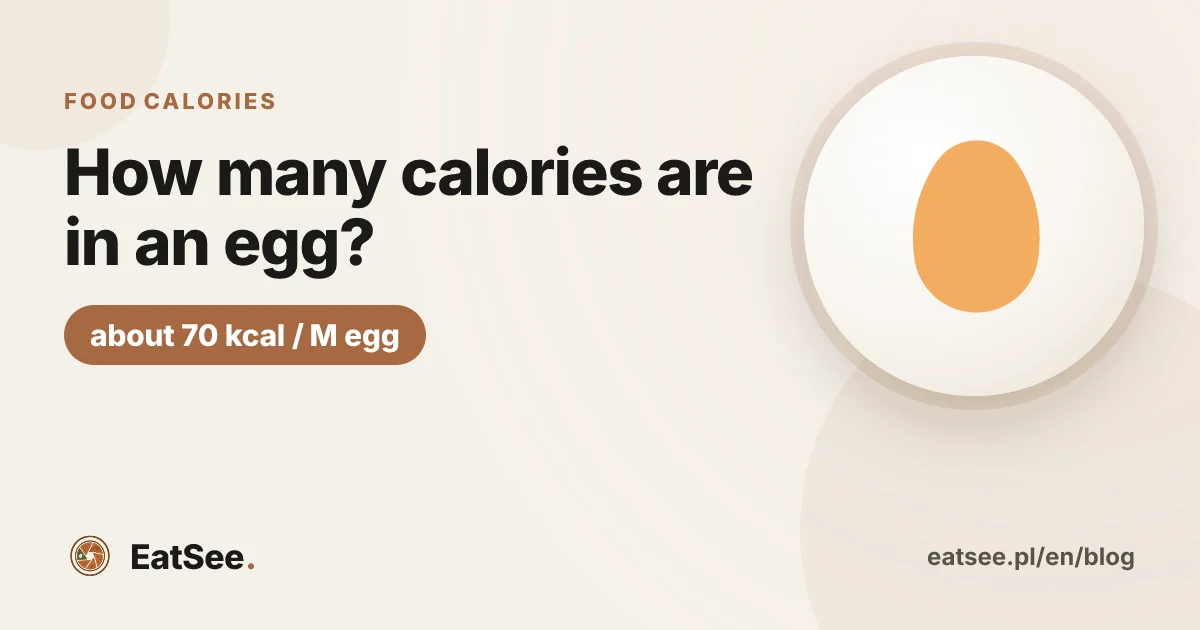
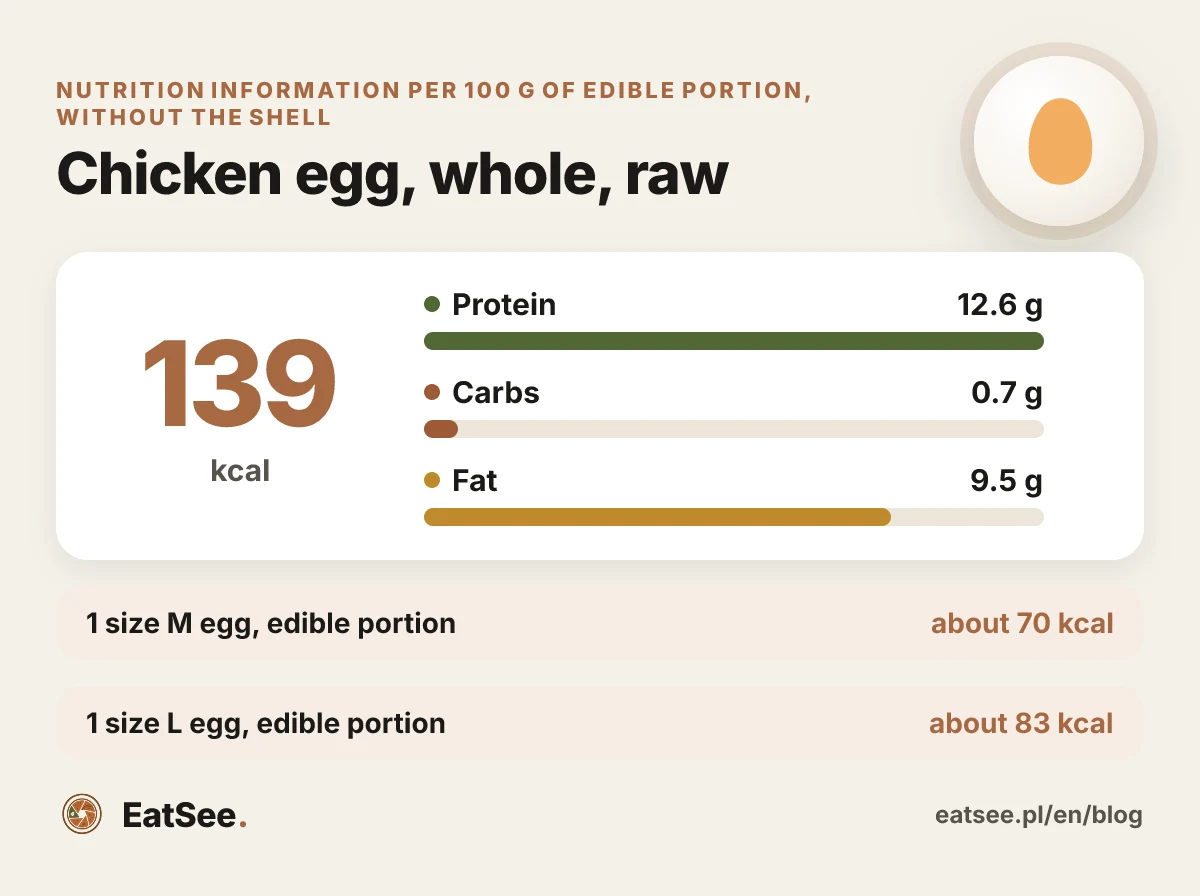
How many calories are in an egg? A whole raw egg has about 139 kcal per 100 g of edible portion, and a size M egg provides about 70 kcal. Depending on the size, that’s about 56 kcal for S, 70 kcal for M, 83 kcal for L, and 97 kcal for XL. Boiling doesn’t add calories, but fat used for frying does.
- 1 size M egg, edible portionabout 70 kcal
- 1 size L egg, edible portionabout 83 kcal
How many calories are in size S, M, L, and XL eggs?
Egg size is based on its weight with the shell. For calorie tracking, though, what matters is what ends up on your plate. The table shows the approximate weight of the edible portion and the resulting calorie content of a raw egg.
| Size | Egg weight with shell | Assumed weight without shell | Calories |
|---|---|---|---|
| S | under 53 g | about 40 g | about 56 kcal |
| M | 53-63 g | about 50 g | about 70 kcal |
| L | 63-73 g | about 60 g | about 83 kcal |
| XL | at least 73 g | about 70 g | about 97 kcal |
These are estimates, as shell size and the proportions of white and yolk can vary. The easiest figures to remember are about 70 kcal for a size M egg and about 83 kcal for a large size L egg. For a more accurate count, weigh the egg after cracking it or use its average edible weight.
100 g of raw egg also contains about 12.6 g of protein, 0.7 g of carbs, and 9.5 g of fat. For more on how to include foods like these in your daily calorie total, read our guide on how to count calories.
Do boiled, fried, and raw eggs have the same number of calories?
Heating an egg doesn’t add energy. The same size M egg will have a similar calorie content raw, boiled, or fried in a pan without fat. The difference comes when you add oil, butter, or other ingredients.
| How a size M egg is prepared | Approximate calories per serving |
|---|---|
| Raw, without shell | about 70 kcal |
| Hard- or soft-boiled | about 70 kcal |
| Fried in a pan without fat | about 70 kcal |
| Fried with 5 g of oil | about 115 kcal |
| Fried with 5 g of butter | about 106 kcal |
A teaspoon of oil weighs about 5 g and provides about 45 kcal. The same amount of butter has about 36 kcal. In practice, some of the fat may stay in the pan, so not all of it necessarily ends up in your meal.
Don’t directly compare calories in 100 g of raw egg with calories in cooked egg. Cooking changes the water content, so the calories in 100 g may look different, even though cooking itself doesn’t add energy. For everyday tracking, it’s easier to count the calories in a whole egg and add any fat used in the pan separately.
Raw eggs can carry a risk of infection. If you want to reduce this risk, choose eggs that are thoroughly cooked, especially when preparing a meal for someone who is particularly vulnerable.
How many calories are in the egg white and yolk separately?
Most of an egg’s calories are in the yolk, which contains most of the fat. The white has fewer calories and provides a substantial share of the egg’s protein.
In a typical size M egg, the edible portion weighs about 50 g: the white is about 33 g and the yolk about 17 g. Approximately, the calories are divided as follows:
| Part of a size M egg | Weight | Calories | Protein |
|---|---|---|---|
| Protein | about 33 g | about 16 kcal | about 3.6 g |
| Yolk | about 17 g | about 54 kcal | about 2.7 g |
| Whole egg | about 50 g | about 70 kcal | about 6.3 g |
Values for each part separately are approximate, but they give a good idea of the proportions: the white provides more protein, while the yolk contains most of the fat and calories. That doesn’t mean you need to automatically discard the yolk. To learn about your approximate needs for this macronutrient, read our article on how much protein you need per day.
How many calories are in scrambled eggs made with 2–3 eggs?
Plain scrambled eggs have about as many calories as the eggs used to make them. With M eggs, that’s about 140 kcal for two eggs or 210 kcal for three. Salt and pepper alone won’t make a significant difference.
| Scrambled eggs made with M eggs | Plain | With 5 g butter |
|---|---|---|
| With 2 eggs | about 140 kcal | about 176 kcal |
| With 3 eggs | about 210 kcal | about 246 kcal |
Add-ins can easily change the total. About 30 ml of milk at 2% fat adds another 15 kcal, while 20 g of cheese can add roughly 70 kcal. Bacon, sausage, or extra butter will also increase the calorie count—sometimes more than you might expect at first glance.
If you make scrambled eggs by eye, log the number of eggs and the amount of fat. You don’t need to weigh every grain of salt. This guide on how to estimate a serving without a scale may also help.
What affects an egg’s calorie content the most?
The egg size and whether you add fat make the biggest difference. An S egg and an XL egg can differ by about 41 kcal, and 5 g of cooking oil adds another roughly 45 kcal. Scrambled egg add-ins like cheese or bacon count separately.
The cooking method also affects the weight of the finished dish. A boiled egg weighs differently from a raw one, while a fried egg may lose some water. So when comparing foods, it’s easier to look at the calories in the whole serving, not just per 100 g.
If you eat eggs regularly, you don’t have to recreate the entire recipe down to the gram every time. Just log similar servings consistently and remember to include fat and add-ins. Find more practical tips in our guide to counting calories day to day.
How do you count eggs in your daily meal plan?
For a simple breakfast, you can count on an M egg having about 70 kcal and an L egg about 83 kcal. For a fried egg, include the fat that actually ends up on your plate. For scrambled eggs, log the number of eggs, butter or oil, and calorie-dense add-ins like cheese.
If you don’t have a scale handy, use the size shown on the package and the approximate values in the chart. When you’re making a meal with several ingredients, it’s easier to calculate the total by logging them one at a time. Or, if you’d rather estimate a meal from a photo, EatSee lets you upload one and check the estimated calories and macronutrients—see how the photo calorie tracker works.
The key point? It’s not the egg alone that determines how many calories are in your breakfast, but the serving size and what you add to it. A boiled egg with a slice of bread is a different meal from scrambled eggs cooked in butter with cheese and bacon—and both can have a place in your meal plan.
FAQs
How many calories are in one M egg?
How many calories are in a fried egg?
How many calories are in scrambled eggs made with 2 eggs?
Does a boiled egg have fewer calories than a raw egg?
How much protein is in an M egg?
Does the yolk have more calories than the white?
This article is for informational purposes and does not replace advice from a doctor or dietitian. Nutrition information is approximate—it depends on the variety, brand, and preparation method. Check the product packaging for exact information. This article was prepared by the EatSee editorial team. Editorial policy.