 EatSee
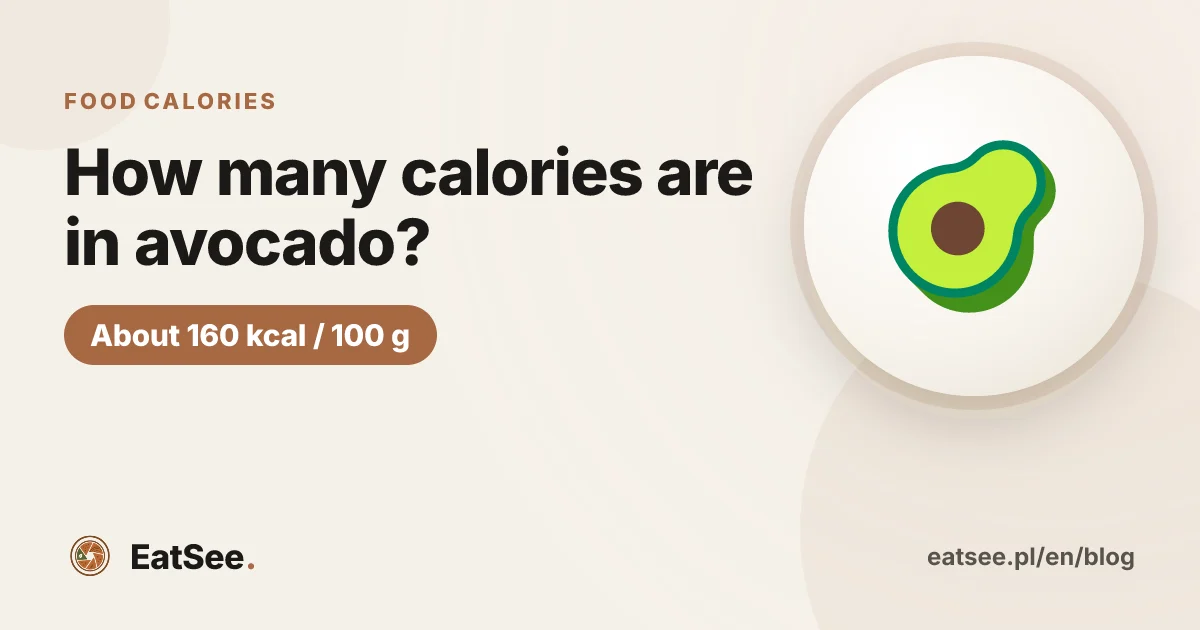
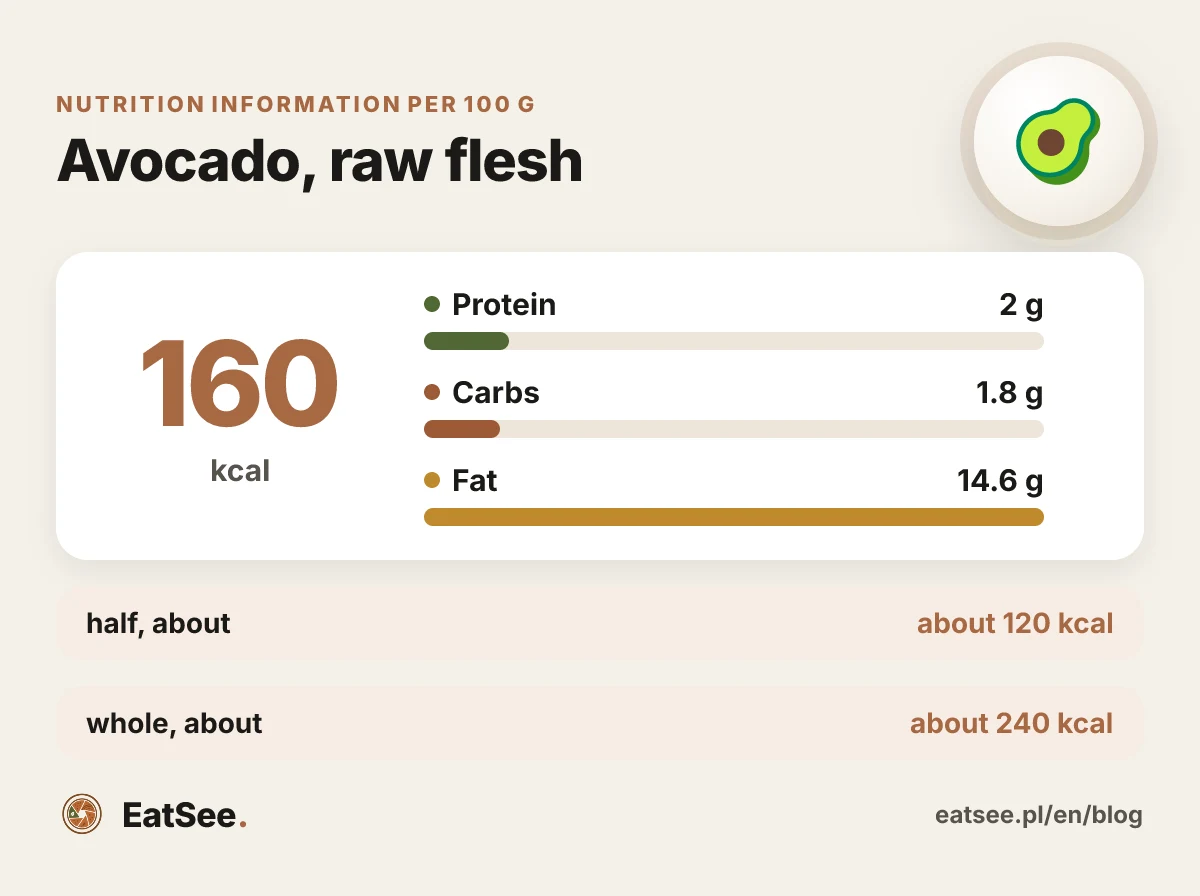
How many calories are in an avocado? There are about 160 kcal in 100 g of flesh; half an avocado with about 75 g of flesh provides about 120 kcal, while a whole one with about 150 g has about 240 kcal. Avocado is high in fat, but most of its fat is unsaturated. It can fit into a weight loss plan-the portion and your overall daily energy balance matter.
- half, aboutabout 120 kcal
- whole, aboutabout 240 kcal
How many calories are in 100 g of avocado, half an avocado, and a whole one?
The easiest way to compare portions is to weigh the flesh alone, without the pit and skin. As a rough guide, an average half weighs 75 g, and the whole edible portion weighs 150 g. Here’s how the calories compare:
| Avocado portion | Flesh | Calories | Fat |
|---|---|---|---|
| 100 g of flesh | 100 g | about 160 kcal | about 14.6 g |
| Half | about 75 g | about 120 kcal | about 11 g |
| Whole | about 150 g | about 240 kcal | about 22 g |
These are useful estimates for a quick comparison, but not all avocados are the same. One may have more or less flesh, so if you want a more accurate portion estimate, weigh it after peeling and removing the pit. The calculation is simple: multiply the calories per 100 g by the portion weight, then divide by 100.
Find more information about this food in the avocado calorie chart. Just remember to compare flesh with flesh-the weight of a whole fruit with its pit and skin is not the same as the weight of the portion you’ll eat.
What nutrition information does avocado provide?
Avocado mainly provides fat. There are about 14.6 g in 100 g of flesh, most of it unsaturated. It also contains fiber, a small amount of protein, and few sugars.
| Nutrient per 100 g of flesh | Amount |
|---|---|
| Energy | about 160 kcal |
| Protein | about 2 g |
| Available carbs | about 1.8 g |
| Fat | about 14.6 g |
| Fiber | about 6.7 g |
| Sugars | about 0.7 g |
The carbs in the table refer to available carbs, with fiber listed separately. With this format, the energy from protein, carbs, fat, and fiber adds up to about 160 kcal. Values are rounded and may vary slightly depending on the variety and ripeness of the fruit.
Avocado isn’t a high-protein food, so it can’t replace a source of protein in a meal. But it can add a creamy texture to a sandwich and bring variety to a salad. To compare it with other foods, see the fruit calorie chart.
Does avocado cause weight gain?
No food causes weight gain on its own. Whether your body weight goes up, down, or stays the same depends mainly on your energy balance over time. Avocado can be part of your meal plan, just like bread, pasta, or dessert.
Keep in mind, though, that avocado is high in calories for its volume. That’s because it contains a lot of fat, which provides about 9 kcal per gram. A tablespoon of mashed flesh and a whole avocado are very different portions, even if both may look modest on a sandwich.
You don’t have to treat avocado as off-limits. If you eat it often, simply pay attention to your portion size and what else is in your meal. It’s easier to keep track of the big picture when you know your approximate daily calorie needs and understand how a calorie deficit works.
Can avocado fit into a weight loss plan?
Yes. You don’t need to cut out foods just because they’re higher in calories when trying to lose weight. Avocado can be a tasty addition to a sandwich, salad, or spread, as long as the portion fits your daily goal. There’s also no need to make every meal as low in calories as possible-the overall eating pattern matters, and it should be satisfying and sustainable.
If you want avocado in your meal but don’t plan to eat a whole one, weigh out, for example, 50 g of flesh. This portion has about 80 kcal. Add it to a sandwich with egg or to a salad with vegetables and a source of protein. That makes it easier to plan a satisfying meal instead of focusing only on reducing its size.
Ready-made meal plans can give you ideas when planning your menu, but you don’t have to follow a plan down to the last crumb. Changing ingredients or portions is normal. If trying to lose weight becomes difficult or you have a condition that requires a special diet, talk to a dietitian or doctor about your eating habits.
How do you count the calories in avocado in your meal?
The simplest way is to weigh the edible portion and calculate its calories based on 100 g. If 100 g of flesh has about 160 kcal, then 50 g has about 80 kcal, and 75 g has about 120 kcal. Don’t weigh the pit or skin, since you don’t eat them.
If you don’t have a scale, estimate that half of an average avocado is about 75 g of flesh. For a very large or small avocado, though, this estimate may be quite different from the actual weight. In that case, try this simple way to estimate portions without a scale.
When counting the calories in a whole meal, remember to include the extras. Avocado on a slice of bread is not the same as avocado with bread, egg, cheese, and sauce-each ingredient adds its own calories. Find more practical tips in our guide to counting calories. You can also use a photo calorie tracker: EatSee estimates calories and macronutrients from a photo of your meal, and you can adjust the portion. It’s a helpful estimate, not a precise measurement down to the gram.
How can you add avocado to a meal without guessing?
Slice it onto a sandwich, add it to a salad, or mash it into a spread. If you’re making guacamole or another dip, include all the ingredients in your estimate, not just the avocado. Adding olive oil, seeds, or cheese can change the calories in the whole portion, even if the amount of avocado stays the same.
A good habit is to choose your serving before you eat-for example, put half the fruit in a container instead of setting a whole bowl of dip on the table. It’s not about monitoring every bite, just making sure your serving doesn’t catch you by surprise afterward. If you’re eating avocado at a restaurant or someone else’s home, an estimate is fine too. One sandwich that isn’t logged precisely won’t throw off your whole plan.
If you’re counting calories, log your serving as you actually eat it. The fruit’s ripeness affects its taste and texture, but it doesn’t magically change the rule: what matters is the weight of the flesh. Choose an amount that works with your meal and leaves room for other foods you enjoy.
FAQs
How many calories are in a whole avocado?
How many calories are in half an avocado?
Is avocado high in fat?
Does avocado cause weight gain?
Can you eat avocado while trying to lose weight?
This article is for informational purposes and does not replace advice from a doctor or dietitian. Nutrition information is approximate-it depends on the variety, brand, and preparation method. Check the product packaging for exact information. This article was prepared by the EatSee editorial team. Editorial policy.