 EatSee
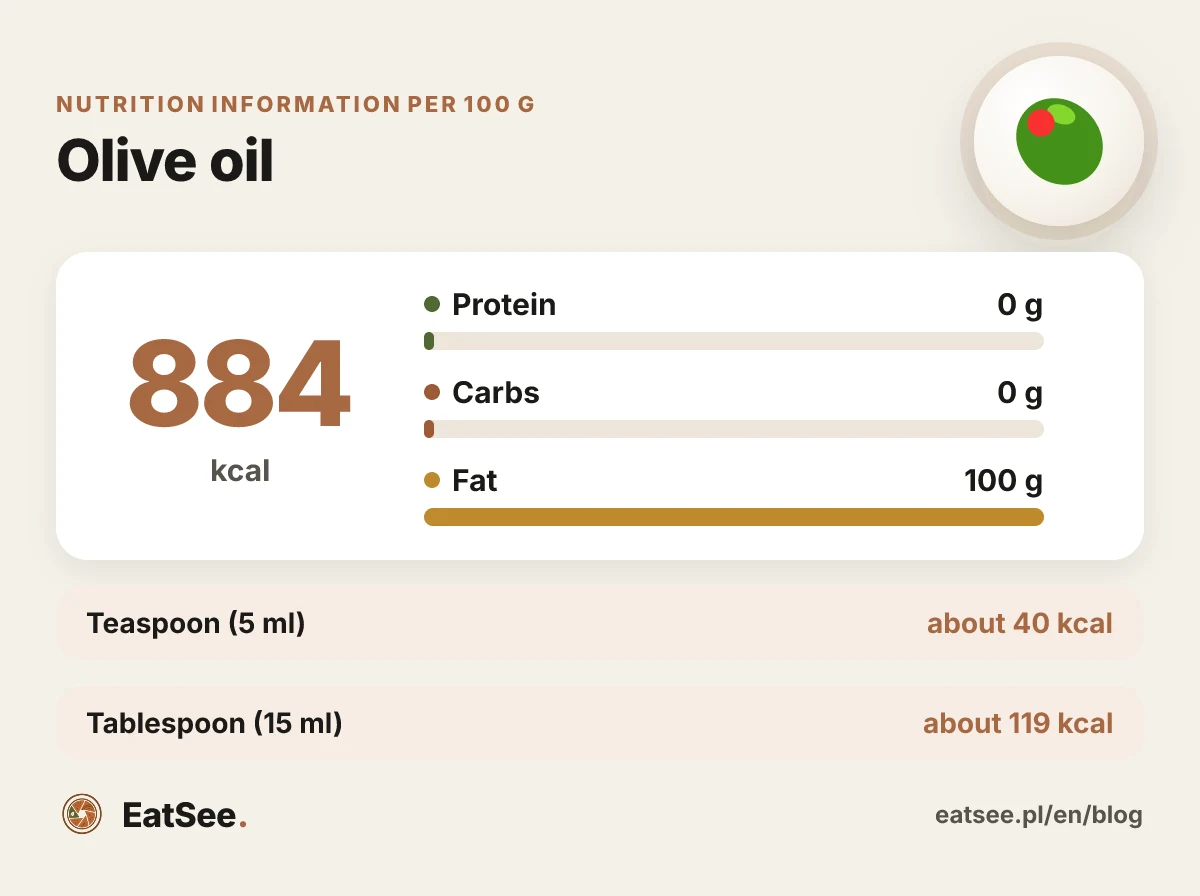
If you’re wondering how many calories are in olive oil, use about 884 kcal per 100 g. A standard teaspoon (5 ml) usually holds about 4.5 g and contains 40 kcal, while a tablespoon (15 ml) holds about 13.5 g and contains 119 kcal. Olive oil and canola oil have similar calorie counts; butter contains fewer calories for the same weight.
- Teaspoon (5 ml)about 40 kcal
- Tablespoon (15 ml)about 119 kcal
How many calories are in 100 g of olive oil?
Olive oil is almost entirely fat, which is why it has a lot of calories in a relatively small serving. Food composition tables often list about 884 kcal per 100 g. In practice, you don’t need to weigh the whole bottle-when cooking every day, the most useful amounts to know are a teaspoon, a tablespoon, and 10 g.
| Olive oil serving | Approximate weight | Calories |
|---|---|---|
| 100 g | 100 g | about 884 kcal |
| 10 g | 10 g | about 88 kcal |
| Teaspoon, 5 ml | about 4.5 g | about 40 kcal |
| Tablespoon, 15 ml | about 13.5 g | about 119 kcal |
The calories in a tablespoon depend on how much olive oil you pour. A capacity of 15 ml is a measure of volume, not a guarantee that every household tablespoon holds exactly that much. The type of olive oil and how you measure it can also make a difference, so treat these figures as practical estimates.
How many calories are in a tablespoon and a teaspoon of olive oil?
With standard kitchen measures, a teaspoon is 5 ml and a tablespoon is 15 ml. Since olive oil is lighter than water, these volumes weigh slightly less than 5 g and 15 g, respectively. For quick calorie tracking, you can use about 4.5 g per teaspoon and about 13.5 g per tablespoon.
Keep in mind that the tablespoon in your kitchen drawer may not hold 15 ml. If you pour olive oil straight from the bottle, you may pour a heaping or incomplete tablespoon, or simply use a larger serving than you intended. Calories add up with the amount: 20 g of olive oil is about 177 kcal, while 5 g is about 44 kcal.
When a recipe calls for a tablespoon and you want a specific amount, use a measuring spoon or weigh the olive oil. A kitchen conversion chart can also help you convert household measures to grams. If you usually cook without a scale, see these tips on estimating a serving without a scale.
Olive oil, canola oil, and butter-which has more calories?
Per 100 g, olive oil and canola oil have very similar calorie counts-about 884 kcal each. Both are plant-based fats, so swapping one for the other won’t suddenly make a dish much lower in calories. The amount you add makes a bigger difference.
Butter has fewer calories per 100 g because, in addition to fat, it contains water and small amounts of other ingredients. Food composition tables often list about 717 kcal per 100 g. It’s still a high-calorie food, but 10 g of butter is about 72 kcal, while 10 g of olive oil is about 88 kcal.
| Ingredient | Calories per 100 g | Calories per 10 g serving |
|---|---|---|
| Olive oil | about 884 kcal | about 88 kcal |
| Canola oil | about 884 kcal | about 88 kcal |
| Butter | about 717 kcal | about 72 kcal |
It’s worth comparing similar serving sizes, not just nutrition information per 100 g. A tablespoon of olive oil weighs about 13.5 g and contains about 119 kcal, while a similar amount of butter contains fewer calories. Find more information about other foods in the calorie chart for fats and oils.
How can you measure olive oil without guessing?
The easiest way is to weigh the bottle before and after pouring the olive oil. The difference on the scale shows how many grams you used-no need to wonder whether the spoon was full. If you have a kitchen scale, you can also place a bowl or pan on it, tare the scale, and pour out the amount you need.
A simple routine works well for everyday cooking:
- For salads: measure a teaspoon or tablespoon instead of pouring olive oil straight from the bottle.
- For frying: add a measured amount to the pan, such as 5-10 g, and log it.
- For baking: weigh the olive oil with the other ingredients or use a graduated measuring cup.
- For a recipe: if you’re not sure whether the author means a full tablespoon, check whether they also give the weight.
Not all the fat you add will necessarily end up in the finished dish. Some may stay in the pan or dish, while some will be absorbed by the ingredients. If you want to log it more accurately, the easiest approach is to count the olive oil you actually added to your serving. When you count calories regularly, it helps to use the same measuring method each time instead of logging a teaspoon one day and a large, unmeasured pour the next.
Does olive oil cause weight gain, and should you count it?
Olive oil alone doesn’t cause weight gain outside the context of your overall meal plan. However, it packs a lot of energy into a small volume, so an extra serving can be easy to overlook-especially in a salad, in a pan, or on a slice of bread. If you’re tracking calories, it’s worth counting olive oil just like any other ingredient in your meal.
Olive oil mainly provides fat, which is an important part of an everyday diet. There’s no need to be afraid of it or automatically choose the version with the fewest calories. You can use an amount that suits your needs and the flavor of the dish; if you’re trying to lose weight, simply measure your servings more carefully.
The problem usually isn’t one teaspoon of olive oil on tomatoes, but several uncounted additions throughout the day. A tablespoon in a salad, a little in the pan, and another splash over roasted vegetables can add up to more than the recipe suggests. If you want to keep track of these details, see how to count calories-without having to measure every lettuce leaf to the gram.
How do you count olive oil in a meal?
When preparing a meal, log the amount of olive oil in grams or use a consistent measure. For example, a teaspoon has about 40 kcal, and a tablespoon about 119 kcal. If you're cooking for several people, divide the amount of fat you added by the number of servings, as long as the oil is distributed fairly evenly.
For example, you add 20 g of olive oil to a tray of vegetables, then divide them into four similar servings. Each serving contains an average of 5 g, or about 44 kcal from the oil. In practice, servings may vary a little, but this gives you a better estimate than leaving out the fat or logging all 20 g for a single serving.
If you use a calorie tracker, log olive oil as a separate ingredient, especially when you add it to several dishes throughout the day. This makes it easier to see what causes the difference between a meal's planned and actual calorie content. And if a recipe gives amounts in grams, stick to grams-spoons can hold surprisingly large amounts.
FAQs
How many calories are in a tablespoon of olive oil?
How many calories are in a teaspoon of olive oil?
Does olive oil have more calories than canola oil?
Which has more calories: olive oil or butter?
Should you count the olive oil you add for frying?
This article is for informational purposes and does not replace advice from a doctor or dietitian. Nutrition information is approximate-it depends on the variety, brand, and preparation method. Check the product packaging for exact information. This article was prepared by the EatSee editorial team. Editorial policy.