 EatSee

How many calories are in cheese? Gouda or Edam typically has about 350-360 kcal per 100 g, but a 20 g slice has just about 70 kcal. Fresh mozzarella usually has fewer, about 250-280 kcal per 100 g, while light versions vary. The calorie count depends on the type of cheese and the specific product.
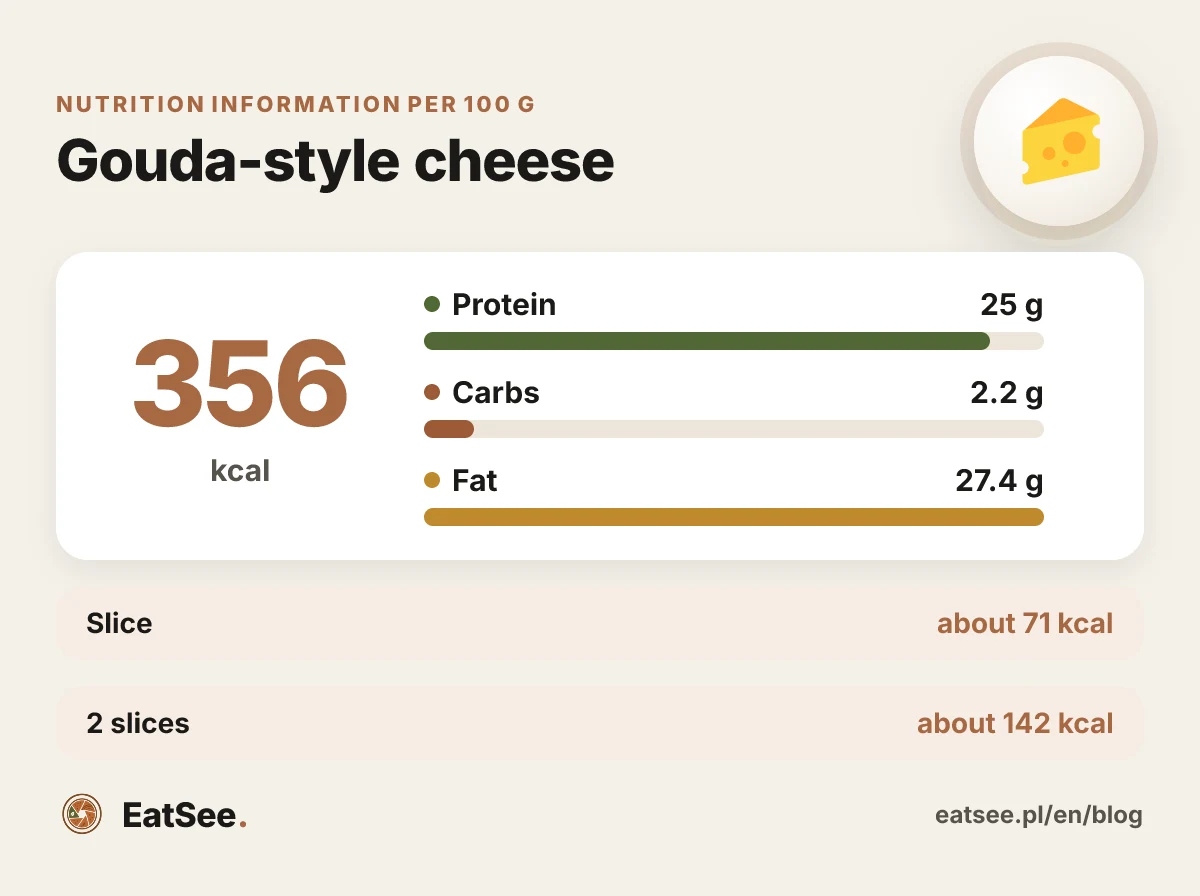
- Sliceabout 71 kcal
- 2 slicesabout 142 kcal
How many calories are in 100 g of cheese?
Gouda and Edam have similar calorie counts. Using typical values, Gouda has about 356 kcal per 100 g, while Edam has about 357 kcal. The difference is small-in everyday tracking, the exact serving weight matters more than which of these two cheeses you choose.
| Type of cheese | Calories per 100 g | Calories per 20 g slice |
|---|---|---|
| Gouda | about 356 kcal | about 71 kcal |
| Edam | about 357 kcal | about 71 kcal |
| Fresh mozzarella | about 250-280 kcal | about 50-56 kcal |
| Light cheese | often about 250-300 kcal | about 50-60 kcal |
These are approximate values, and a particular Gouda or light cheese may have a different calorie count. To compare more dairy products, see the dairy calorie chart. For light cheese, it’s especially worth checking the packaging-the label “light” doesn’t indicate one fixed value.
How many calories are in a slice of cheese?
A slice of cheese doesn’t have a standard weight. A thin slice from a package may weigh about 15 g, a standard slice often about 20 g, and a thicker one as much as 25 g. For Gouda, that works out to about 53, 71, and 89 kcal, respectively.
Here’s the simplest way to calculate it: multiply the calories per 100 g by the serving weight, then divide by 100. For a 30 g serving of Gouda, the calculation is: 356 × 30 ÷ 100 = about 107 kcal. Two 20 g slices add up to about 142 kcal.
If you don’t have a scale, treat the result as an estimate-not a math test while making a sandwich. You can weigh your usual slice once to make it easier to estimate the next ones. For pre-sliced cheese, also check how many slices are in the stated package weight.
Gouda, Edam, mozzarella, and light cheese-what’s the difference?
Gouda and Edam are hard cheeses that typically contain around 350-360 kcal per 100 g. Differences between brands are due in part to fat content and moisture. Similar names don’t guarantee identical nutrition information.
Mozzarella needs a little clarification. Fresh mozzarella, usually sold in brine, contains more water and generally has fewer calories than hard Gouda. Lower-moisture mozzarella, such as the kind used for pizza, may have a different calorie count-check the label for the specific product.
Cheeses labeled light often have less fat and fewer calories than their full-fat counterparts, but there’s no single value that applies to all of them. Compare the nutrition information per 100 g, not just the claim on the front of the package. Also check protein and salt, since calories aren’t the only useful information when choosing a cheese.
How much protein and fat does cheese have?
100 g of Gouda contains approximately 25 g of protein, 27.4 g of fat, and 2.2 g of carbs. A 20 g slice contains about 5 g of protein. Exact proportions depend on the product, so treat these numbers as an example, not a universal profile for every cheese.
Cheese also provides calcium, but it can be salty and packs a lot of energy into a small volume. That’s not a drawback, just useful to know: it’s easy to eat two thin slices while chatting and packing sandwiches, and they can add up to more calories than a single vegetable snack. If you’re interested in more sources of protein, check out high-protein foods.
Does cheese cause weight gain?
No food causes weight gain on its own. Body weight changes in response to your overall daily food intake and energy expenditure, and cheese can fit into a diet for weight maintenance or weight loss. Just keep in mind that it has a lot of calories in a small serving, so it’s easy to underestimate an extra slice.
Cheese can be a satisfying sandwich topping, but count it along with the bread, butter, and other ingredients. If you have two cheese sandwiches for breakfast, you don’t need to give up cheese-just check how much the slices weigh and how the whole meal fits into your plan. Read more about how weight loss works in our article on the calorie deficit.
How do you count calories in cheese every day?
Start with the label: find the calories per 100 g, estimate or weigh your serving, and calculate the calories for the amount you’re having. If the package says 356 kcal per 100 g, a 40 g serving has about 142 kcal. This works for grated Gouda in a casserole, too-weigh what you add instead of guessing whether it’s a handful or just a little cloud of cheese.
A useful approach:
- track the weight of the cheese if you eat it often and want a more accurate estimate;
- for slices, use about 20 g as a rough estimate until you check their weight;
- compare products per 100 g and check their fat, protein, and salt content;
- count cheese as part of the whole sandwich, salad, or casserole-not as a separate meal.
If you log your meals, EatSee can estimate calories and macronutrients from a photo or a single sentence. You can adjust the result by changing the serving size-for foods like cheese, it’s still worth entering a realistic weight. Find more practical tips in our guide to counting calories.
You don’t have to cut cheese out of your meal plan just because it’s high in calories. A slice or two, or mozzarella in a salad, can easily be part of your daily menu-it’s the serving size, the whole meal, and what you eat day to day that count.
FAQs
How many calories are in one slice of yellow cheese?
How many calories are in 100 g of Gouda?
Does light yellow cheese have fewer calories?
Does yellow cheese cause weight gain?
How many calories are in mozzarella?
This article is for informational purposes and does not replace advice from a doctor or dietitian. Nutrition information is approximate-it depends on the variety, brand, and preparation method. Check the product packaging for exact information. This article was prepared by the EatSee editorial team. Editorial policy.