 EatSee
How many calories are in rosół (Polish broth)? A 300 g serving of clear soup without noodles provides about 108 kcal, assuming an average of 36 kcal per 100 g. Noodles increase the calorie count: 50 g of cooked noodles add about 75 kcal, bringing the whole bowl to about 183 kcal in this example. Chicken and beef broth can differ, mainly because of their fat content.
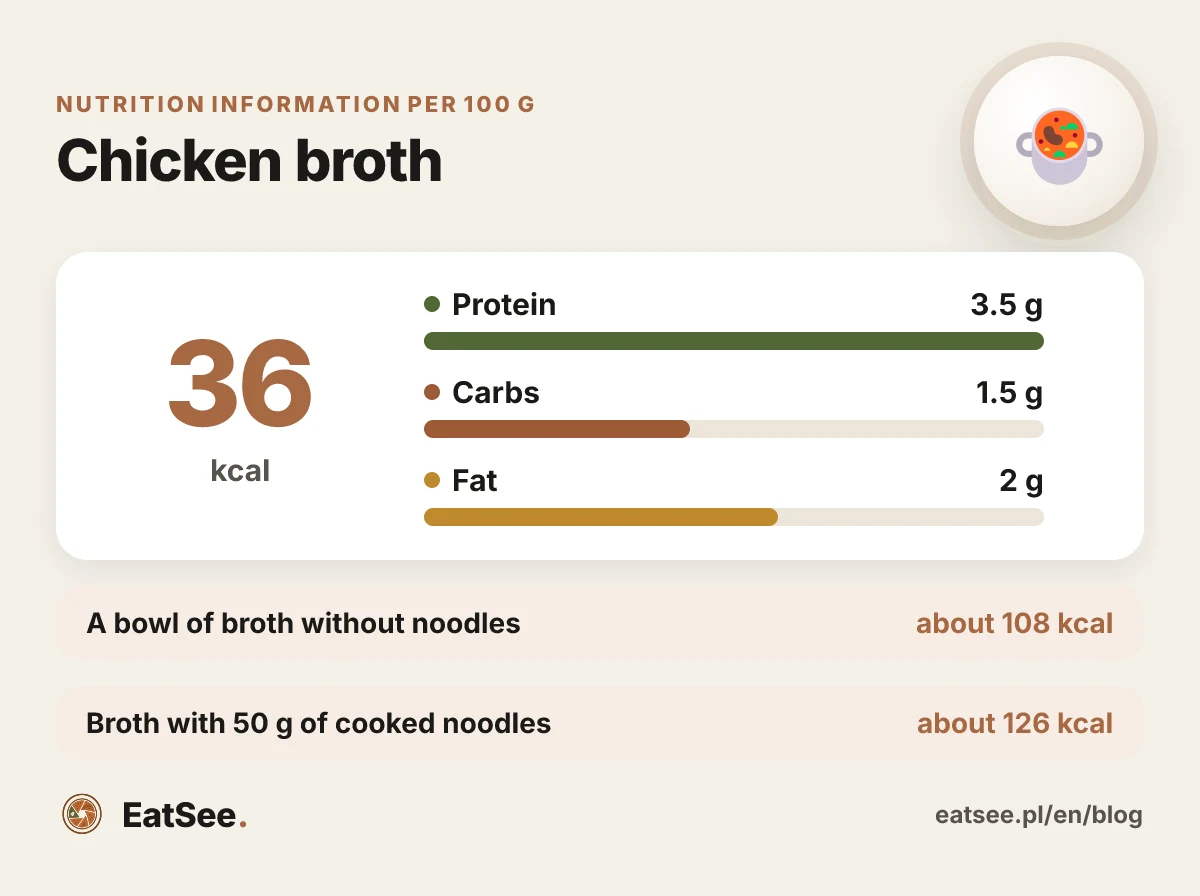
- A bowl of broth without noodlesabout 108 kcal
- Broth with 50 g of cooked noodlesabout 126 kcal
How many calories are in broth without noodles?
The calorie count for broth alone depends on the recipe, but about 36 kcal per 100 g is a useful reference. For typical servings, that works out to:
| Serving of broth without noodles | Estimated calories |
|---|---|
| 100 g | about 36 kcal |
| 300 g, roughly one bowl | about 108 kcal |
| 400 g, a larger serving | about 144 kcal |
These are estimates, since homemade broth can vary: some cooks skim the fat off the surface, while others leave more of it in. The amount of meat, skin, bones, and vegetables used also matters. You can also find a calorie chart for this dish in our broth calorie chart.
Keep in mind that this refers to the liquid and vegetables alone, not meat taken from the pot or additions served in the bowl. If you add a substantial serving of meat to your soup, count its calories separately. Details like these can make two bowls labeled “broth” vary in calorie content.
How many calories are in broth with noodles?
The easiest way is to count the noodles as a separate ingredient. Cooked noodles contain about 150 kcal per 100 g on average, so 50 g is roughly 75 kcal, while 100 g is about 150 kcal. The exact amount depends on the type of noodles and how much water they absorbed while cooking.
| Serving ingredients | Estimated calories |
|---|---|
| 300 g of broth + 50 g of cooked noodles | about 183 kcal |
| 300 g of broth + 100 g of cooked noodles | about 258 kcal |
| 400 g of broth + 50 g of cooked noodles | about 219 kcal |
This calculation uses 36 kcal per 100 g of broth and 150 kcal per 100 g of cooked noodles. If you usually pour soup “by eye,” the difference between a small handful of noodles and a heaped serving may be bigger than you think. Read more about how the calorie count of noodles changes before and after cooking in our article on how many calories are in noodles.
Is chicken broth lower in calories than beef broth?
Not always. Lean chicken broth may have fewer calories than fatty beef broth, but chicken broth made with the skin on or with plenty of fat may have a similar or higher calorie count than well-skimmed beef broth. The type of meat alone isn't enough to accurately assess a bowl.
As a rough guide, a 300 g serving may provide about 75-120 kcal for chicken broth and about 90-135 kcal for beef broth. These are broad ranges, not hard-and-fast rules. If the broth has a thick layer of fat after chilling, removing it will lower the soup's calorie count. Count any meat served in the bowl separately.
What has the biggest effect on broth's calorie count?
Fat and additions make the biggest difference. Clear, defatted broth will be lighter than soup made with fatty meat, with the fat left on the surface. More meat, noodles, drop noodles, or an extra tablespoon of butter can also raise the calorie count.
Keep a few things in mind when comparing servings:
- Noodles and other additions-count their calories in addition to the soup, rather than treating the whole bowl as broth alone.
- Serving size-400 g of liquid has more calories than 300 g, even if the recipe is identical.
- Fat from the meat-skin and fatty cuts can increase the calorie count of the broth.
- Meat in the bowl-this is a separate ingredient, and its calorie content depends on the type and amount.
- Vegetables-carrots and parsley root usually won't change the calorie count as much as noodles, but they're still part of the serving.
Salt itself has no calories. However, it may cause your weight to temporarily read higher the next day due to water retention-that's not the same as gaining body fat.
Does broth cause weight gain?
No single food causes weight gain on its own. Changes in body weight are mainly determined by your energy balance over time, not by whether you eat broth on a particular Friday. A serving of clear broth alone is usually fairly light, but noodles, meat, and seconds add to the calorie count of the meal.
If you want to lose weight, you don't have to give up broth. You can choose the amount of noodles that works for you, add meat, and include all the ingredients in your daily calorie balance. There's also no need to “make up for” lunch by fasting or doing an intense workout. Take a relaxed approach and look at your overall eating habits.
If you're just getting to know your daily calorie needs, you may find our articles on how to count calories and what a calorie deficit is helpful. You don't need to get every calorie exactly right-consistency and a reasonable sense of serving sizes matter more.
How can you calculate the calories in the broth in your bowl?
At home, you can estimate your serving in a few steps:
- Weigh or estimate the amount of broth alone. For example, 300 g at 36 kcal per 100 g comes to 108 kcal.
- Add the noodles based on their cooked weight. In this example, 50 g is about 75 kcal.
- Count the meat if you eat it with the soup, as well as any other additions.
- If you make a large pot, divide the calories from all the ingredients by the number of servings. It's easier than guessing how much is in each ladleful.
You can also take a photo of your plate or describe the meal in one sentence in the photo calorie tracker. EatSee estimates calories and macronutrients, and you can adjust the result by changing the serving size or ingredients. This can be useful with homemade chicken broth, since a photo won’t show exactly how much pasta is underneath the broth.
Is broth a good choice for a light meal?
It can be part of a light meal, especially if you choose skimmed broth and adjust the amount of pasta to your appetite. The broth itself provides little protein compared with a serving of meat, so chicken broth with meat will be more filling and nutritious. If you get hungry soon after having soup on its own, there’s no need to force yourself to skip the extras.
For example, a bowl with 300 g of chicken broth and 50 g of cooked pasta has about 183 kcal, before you add the meat. It can be part of lunch, but it may not be a complete meal for everyone - that depends on your needs and what you eat throughout the day. The most important thing is to choose a serving that works for you, rather than relying on a universal “healthy” or “unhealthy” label.
FAQs
How many calories are in a bowl of chicken broth without pasta?
How many calories are in chicken broth with pasta?
Is chicken broth lower in calories than beef broth?
Does chicken broth make you gain weight?
How many calories are in 400 g of chicken broth without pasta?
This article is for informational purposes and does not replace advice from a doctor or dietitian. Nutrition information is approximate-it depends on the variety, brand, and preparation method. Check the product packaging for exact information. This article was prepared by the EatSee editorial team. Editorial policy.