 EatSee
How many calories are in Polish curd cheese? It mainly depends on the fat content: low-fat Polish curd cheese has about 98 kcal per 100 g, semi-fat has about 132 kcal, and full-fat has about 176 kcal. All types provide plenty of protein-roughly 18-20 g per 100 g. For comparison, cottage cheese has about 97 kcal, while plain quark has about 156 kcal per 100 g.
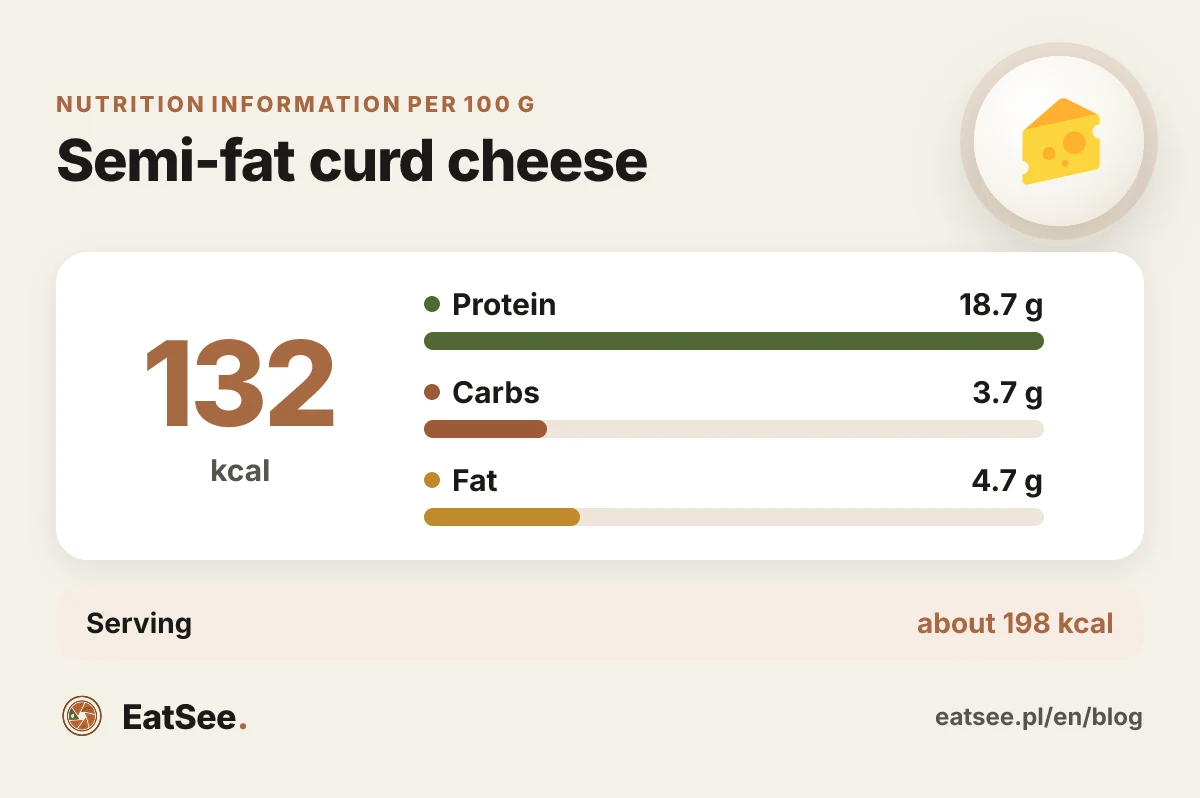
- Servingabout 198 kcal
How many calories are in low-fat, semi-fat, and full-fat Polish curd cheese?
The easiest way to compare products is by looking at the same amount, such as per 100 g. The figures below are estimates-the actual value depends on the manufacturer, ingredients, and fat content. For more precise tracking, the package label is the best source for the specific product.
| Ingredient | kcal per 100 g | Protein | Fat | Carbs | kcal per 150 g |
|---|---|---|---|---|---|
| Low-fat quark (Polish fresh cheese) | about 98 | about 19.8 g | about 0.5 g | about 3.5 g | about 147 |
| Semi-fat curd cheese | about 132 | about 18.7 g | about 4.7 g | about 3.7 g | about 198 |
| Full-fat Polish curd cheese | about 176 | about 18 g | about 10 g | about 3.5 g | about 264 |
| Cottage cheese | about 97 | about 11.5 g | about 4.5 g | about 2.5 g | about 146 |
| Plain quark | about 156 | about 8 g | about 12 g | about 4 g | about 234 |
The difference between low-fat and full-fat Polish curd cheese mainly comes from the fat-their protein content is similar. That’s why the term Polish curd cheese alone isn’t enough if you want to estimate calories. Check the type and the nutrition information on the package.
It’s also worth checking the ingredients and protein content, not just the calories. Find more tips in our guide to reading food labels and dairy calorie chart.
How many calories are in a serving of Polish curd cheese?
In the kitchen, you rarely use exactly 100 g. If you scoop out Polish curd cheese with a spoon or eat a piece straight from the package, calculate the serving proportionally: multiply the calories in 100 g by the serving weight and divide by 100.
For example, 150 g of semi-fat Polish curd cheese has about 198 kcal. A whole 250 g package of the same product provides about 330 kcal. For low-fat Polish curd cheese, 150 g has about 147 kcal, while for full-fat Polish curd cheese it has about 264 kcal.
Remember that the serving in the table is only for comparison. Packages and servings you put on a sandwich or in a bowl may weigh differently. If you don’t have a scale, try weighing your usual serving once or twice-it’ll be easier to estimate by eye afterward. You may also find this simple way to estimate portions without a scale helpful.
Add any extras to the calories in Polish curd cheese. A teaspoon of honey, sugar, cream, chives, or radishes can change the calories in the whole dish by varying amounts. Polish curd cheese on its own may be light, but a bowl with honey, nuts, and granola is a very different snack-and it can still taste great; just remember to count everything.
Which type of Polish curd cheese has the most protein?
Per 100 g, low-fat Polish curd cheese usually has the most protein-about 19.8 g. Semi-fat provides about 18.7 g, and full-fat about 18 g. The differences aren’t huge, so you don’t have to automatically choose low-fat if you prefer the taste of semi-fat.
Polish curd cheese is an easy way to add protein to breakfast, dinner, or a post-workout meal. Mix it with yogurt, add it to sandwiches or pancakes, or make a herbed spread. To compare it with other foods, see our list of high-protein foods.
When choosing, consider the whole meal, not just one ingredient. Low-fat Polish curd cheese on bread with vegetables can make a filling breakfast, but if you prefer the creamier texture of semi-fat, that’s a reasonable choice too. It’s worth adjusting your protein intake to your needs, activity, and health; if you have kidney disease, consult a doctor or dietitian.
Polish curd cheese vs. cottage cheese and plain quark-which should you choose?
In our comparison, cottage cheese has about 97 kcal and 11.5 g of protein per 100 g. So it has less protein than Polish curd cheese, but it can be a convenient quick snack-especially when you don’t have time to mix or season anything. Check the label, as ingredients and calories vary between products.
Plain quark has about 156 kcal and 8 g of protein per 100 g. Sweetened quark may contain more sugars and calories, so check whether you’re choosing a plain product or a dessert-style one. Differences between brands can be noticeable.
There’s no single best option for everyone. If you want more protein with fewer calories, low-fat Polish curd cheese is usually a convenient choice. If you prefer a milder taste and creamier texture, choose semi-fat Polish curd cheese or cottage cheese and factor the serving into your overall daily intake.
Does Polish curd cheese cause weight gain, and can it fit a weight loss plan?
Polish curd cheese alone doesn’t cause weight gain. What matters is your overall diet and energy intake over time, not a single food. Polish curd cheese can fit into meals for weight loss, weight maintenance, or muscle gain.
Low-fat Polish curd cheese can be practical during weight loss because it provides plenty of protein for relatively few calories. Semi-fat can work too-the difference in a 150 g serving compared with low-fat is about 51 kcal. Choose the one you enjoy and that helps you put together a meal that keeps you satisfied.
Pay attention to what you add. Polish curd cheese with tomato, pepper, and chives has a different calorie content from Polish curd cheese with cream, sugar, and a generous portion of dried fruit and nuts. You don’t need to give up your favorite additions-just include them in your count. If you’re looking for high-protein meal ideas, choosing a serving that suits your goal matters more than following a strict list of forbidden foods.
How do you count calories in Polish curd cheese in an everyday meal?
Start with the label. Check the calories and protein per 100 g, then work out how much quark actually ends up on your plate. If you add bread, fruit, honey, or yogurt, count those separately-they can make a bigger difference than you might think.
You can log ingredients manually or use the photo calorie tracker. EatSee estimates calories and macronutrients from a meal photo or a short description, and you can adjust the result by changing the serving size or ingredients. It’s still an estimate, so for packaged foods, it’s best to use the information on the product label.
Here’s a simple example: weigh 150 g of medium-fat quark, add vegetables and bread, then log each ingredient. That way, you’ll see not only the calories in the quark itself, but also the protein and energy in the whole meal. No pressure-and no pretending every spoonful always weighs the same.
FAQs
How many calories are in 100 g of medium-fat quark?
How many calories are in 200 g of quark?
Which type of quark has the most protein?
How many calories are in country-style and homogenized cheese?
Is low-fat quark better for weight loss than medium-fat quark?
This article is for informational purposes and does not replace advice from a doctor or dietitian. Nutrition information is approximate-it depends on the variety, brand, and preparation method. Check the product packaging for exact information. This article was prepared by the EatSee editorial team. Editorial policy.