 EatSee
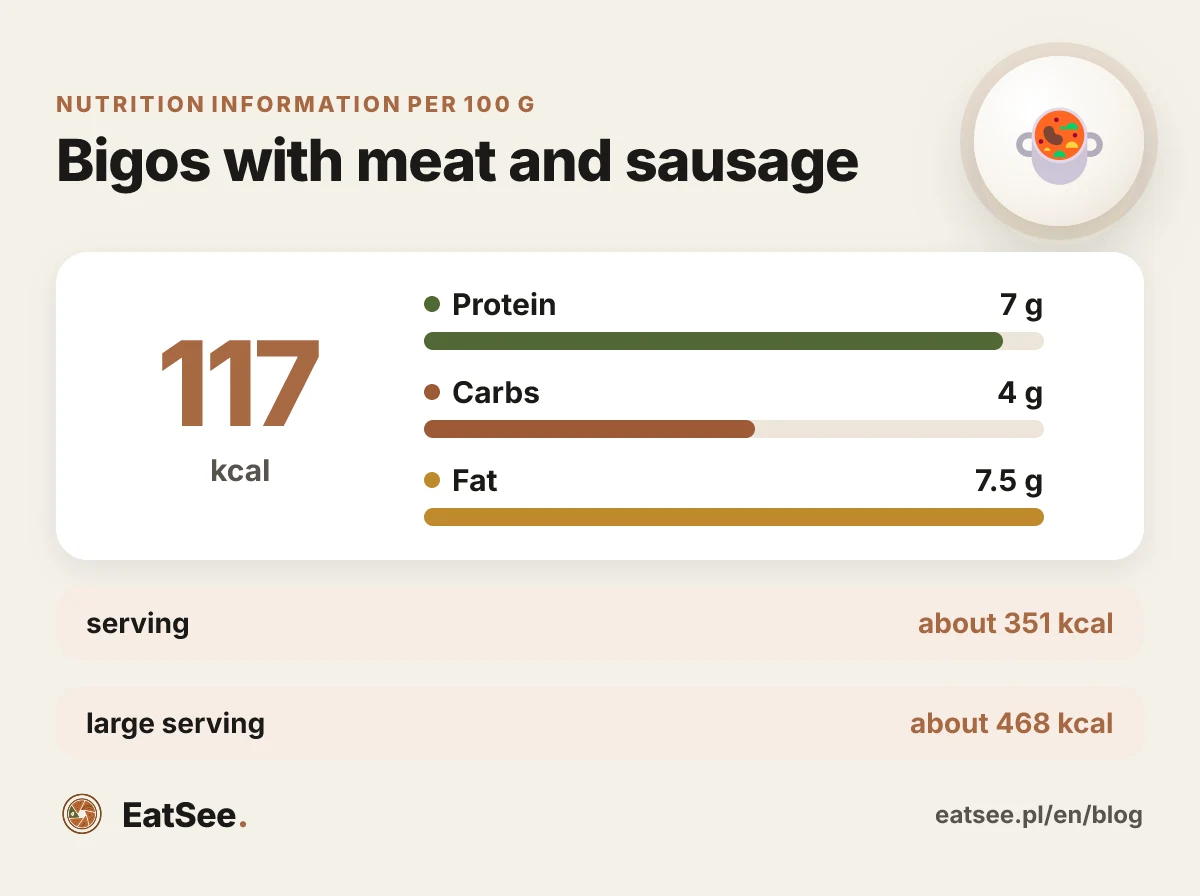
How many calories are in bigos? For a sample version with cabbage, meat, and sausage, allow about 117 kcal per 100 g. A 300 g serving contains about 351 kcal, while 400 g contains about 468 kcal. These are estimates: homemade bigos can be much lighter or higher in calories, depending on the ingredients and their proportions.
- servingabout 351 kcal
- large servingabout 468 kcal
How many calories are in bigos with sausage and meat?
Bigos doesn’t have one fixed calorie count. One pot might be mostly cabbage and lean meat, while another has plenty of sausage, bacon, and fat. That’s why values per 100 g in charts are best treated as a reference, not an exact result for every recipe.
For a fairly typical sample version with meat and sausage, you can allow about 117 kcal per 100 g, including about 7 g of protein, 4 g of carbs, and 7.5 g of fat. Cabbage also provides fiber. A fattier bigos may have more, while a lighter one may have less.
| Amount of bigos | Approximate calorie content |
|---|---|
| 100 g | about 117 kcal |
| 250 g | about 293 kcal |
| 300 g | about 351 kcal |
| 400 g | about 468 kcal |
| 500 g | about 585 kcal |
In the chart, every 100 g is assigned the same value, and the calories in a serving are based on its weight. This makes it easier to estimate what’s on your plate, but doesn’t account for differences between individual recipes.
What affects the calories in bigos?
Meat and fat make the biggest difference. Sauerkraut and fresh cabbage aren’t major sources of energy in this dish. The calorie count goes up when a lot of fatty sausage, bacon, pork neck, or lard goes into the pot.
Other ingredients can be easy to overlook too: oil for frying, dried plums, sugar, or a larger amount of meat. Long cooking alone doesn’t add calories, but it does affect the amount of water in the dish. As the bigos cooks down, the calories become more concentrated in the same weight of finished food.
Versions made with leaner meat and a small amount of sausage may contain about 90-120 kcal per 100 g. More typical, meatier recipes often contain about 110-160 kcal, while a very fatty version may exceed that range. These are broad estimates-a specific recipe can shift the result either way.
If you’re comparing bigos with other dishes, take a look at calories in Christmas Eve dishes. For the calorie content of the meat and cold cuts themselves, see the meat and cold cuts calorie chart.
How much bigos should you serve, and how many calories will it contain?
A bowl of bigos may weigh 250 g, but a large, generously filled plate can easily reach 400-500 g. So it’s worth estimating not just “one plate,” but roughly how much it weighs. If you don’t have a scale, you can use these tips to estimate a serving without a scale.
Using the assumed value of 117 kcal per 100 g, a sample 300 g serving contains about 351 kcal. A 400 g serving has about 468 kcal, before adding bread, potatoes, or other sides. The actual value may differ, especially if the bigos is fatty or contains a lot of sausage.
If you eat bigos with a slice of bread, count it separately. The same goes for potatoes-their calories aren’t included in the value for the bigos itself. Keeping them separate helps you avoid guessing whether a “plate” means just the dish or the whole meal.
Can you eat bigos while losing weight?
Yes. You don’t have to cut out bigos or other traditional dishes to lose weight. What matters more is how your overall eating pattern adds up over time and whether it lets you maintain a reasonable calorie deficit without going hungry or constantly trying to satisfy your appetite afterward.
Day to day, you can serve an amount that suits your appetite and plans, and choose your sides thoughtfully. If the bigos is hearty, try starting with 250-300 g and see if it’s filling. You could also serve it with vegetables or have less bread if you usually eat several slices with it.
There’s no one required serving size for everyone. 300 g may be enough for one person, while a larger amount after a long walk or an active day may feel completely natural. If you want to align your eating more closely with your goal, learn how a calorie deficit works.
How do you count the calories in homemade bigos?
For the most accurate estimate, add up the calories in all the ingredients, then divide the total by the weight of the finished dish. Be sure to weigh ingredients in the state that matches their nutrition information in the chart, and include any fat used for frying.
- Note the amounts of cabbage, meat, sausage, fat, and any other ingredients.
- Check the calories in each ingredient and add them up for the whole recipe.
- Once cooked, weigh the finished bigos, ideally after it has cooked down to the consistency at which you usually serve it.
- Divide the calories in the whole pot by its weight and multiply the result by 100 to get an estimate per 100 g.
- Weigh your serving and calculate its calories proportionally.
For example, if the whole pot contains about 3,000 kcal and weighs 2,500 g, 100 g of bigos contains about 120 kcal. A 300 g serving has about 360 kcal. This is an estimate because ingredients can have different fat content, and the dish loses water as it cooks.
When you log meals as you go, you can also estimate a dish from a photo or a short description. EatSee lets you log a meal from a photo or in a single sentence, and you can adjust the result by changing the serving size or ingredients. This calculation is also an estimate-for homemade bigos, the most helpful details are the approximate ingredients and serving size.
How can you make lighter bigos without sacrificing flavor?
You don’t have to turn bigos into just cabbage. A few simple changes can cut calories while keeping the dish’s character:
- choose leaner meat and use less high-fat sausage or bacon;
- measure the fat you use for frying instead of pouring it straight from the bottle;
- build some of the flavor with spices and slow cooking, rather than relying only on fatty additions;
- weigh your serving if you want a better idea of its calorie content;
- remember that sides on your plate have calories too.
The simplest approach is to compare two pots made in a similar way, but with different amounts of sausage or fat. That way, you’ll see what actually affects the calorie content of a serving and can choose the version you like best. Bigos can be part of weight loss-there’s no need to pretend a holiday meal has to look like a salad.
FAQs
How many calories are in 100 g of bigos?
How many calories are in a 300 g serving of bigos?
How many calories are in bigos with sausage?
Does bigos cause weight gain?
Can you eat bigos while trying to lose weight?
This article is for informational purposes and does not replace advice from a doctor or dietitian. Nutrition information is approximate-it depends on the variety, brand, and preparation method. Check the product packaging for exact information. This article was prepared by the EatSee editorial team. Editorial policy.